Showing posts with label 1950s. Show all posts

Wednesday, February 17, 2021

One Coin Reads 5: The Case of the Vanishing Bandit, by Paul Murry

The Case of the Vanishing Bandit, by Paul Murry

2018, reprinting comics from the 1950s

Fantagraphics make the most beautiful books! I had no intention of buying this, but the two-book slipcase set was marked down 90% to ¥773, how could I not buy it?

Absolutely gorgeous production, right down to the paper quality


(I knew a lady who couldn't handle seeing stray kittens in the street, she had to give them some food and in some cases shelter. That's how I feel when I see comic collections marked down over 80%. They need love, they need a home, and I'm there for it.)

For a lot of this book (only one of the two in the slipcase), I kind of hated it. Going in, you have to accept it's a product of it's time, it's really aimed at kids, and not in a wink-wink EC way. The art quality is fine, but this thing read like a story that they threw together to get out on a deadline. The obvious point of comparison for this book and the whole Disney Masters series is Carl Barks. Fantagraphics is already around 20 books into its Barks' Duck reprints, and they decided he would get a line of books to himself. Murry and some other Disney comics artists are getting a single line to share. Though it probably reflects the realities of publishing, that Murry doesn't have the name draw to justify his own line, Fantagraphics has been willing to create a name for artists they deem worthy. This work seems more in the vein of historically interesting than it is historically important. 
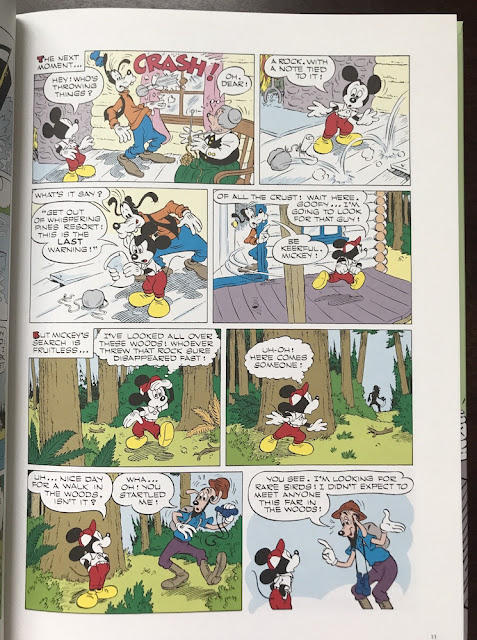
Some nature shots

The big problem I had with it was it felt uninspired. In the Barks books, the world is populated with all manner of character in Duckville. Bringing in Gladstone Gander or Gyro Gearloose gives a little punch to stories, different flavors for each adventure. Here, you get a side character like Chief O'Hara, who is Irish. That's all I could tell you about this character. These are Murry's early stories, and the book notes state that he later created The Phantom Blot, who became Mickey Mouse's comic nemesis, so I might simply have read stories which don't reflect the breadth of Murry's career. 
That final panel: not even a pun or a callback. Just a statement summarizing the plot. It's shaped like a joke, but it isn't one

A much greater flaw is just the construction of the stories themselves. A crime is established in part one, investigated in part two, and solved in part three. There's no real cleverness in the unveiling of the plot, it is textbook writing. No "Chekov's gun", just Mickey solving a mystery in 24 pages. It's not bad, but it's fairly boring.

Some pages are dynamic and have really solid cartooning that would work today, with some updates to the settings
As I read the book, I started to enjoy the illustrations more. I wonder if it was a kind of Stockholm syndrome, but Murry was a strong illustrator with great consistency. I enjoyed the final story in the book the most by far, and flipping back to the first story, the art started looking better than when I first read it.

The lettering looks close to that of Barks' books, and it looks amazing. That was probably my favorite part of the book. I can only dream of that sort of hand-eye coordination.

A guy was trying to blow Mickey and Goofy up with dynamite, but they decide not to press charges. If this was an EC book, he would have gone to the gas chamber
The book notes aren't extensive, but they did help me understand just why the book existed. Murry was a Disney animator in the 40s before doing their comics in the 50s, and continued drawing them into the 80s. In the stories in this book, he wasn't the writer, and that is the weakest part of the book. Apparently, drawing trees and nature was what he enjoyed most. And he created Super-Goof, a character I enjoyed reading a lot as a kid. Murry was a solid comic artist.

I'm glad I read it, and by the end I could find some things to enjoy in the book. If I were to read more of his work, I'd probably want to skip to the 70s to see what he was doing then. But it's not something I'm dying to track down unless it's a good deal.

Sunday, February 7, 2021

Reading Through 2021 20: The Woman Who Loved Life and Other Stories, by Johnny Craig

The Woman Who Loved Life and Other Stories, by Johnny Craig

2019, reprinting material from the early 1950s

I know some of the EC artists by style, but one I really don't know is Johnny Craig. I even have another book of his work from a Fantagraphics EC box set I bought five years ago, but, honestly? I've never sat down and read one of those books cover to cover. I usually read a story or two and just start looking at the pictures. So with this, I decided to actually sit down with it; I read about two stories a day for a week and a half.


At the end of it, I still don't have a handle on Craig as an artist, not like the artists who went on to have broader careers, such as Jack Davis, Al Williamson, or Wally Wood. I can look at those guys' art and recognize it. Craig is more like a Hal Foster type artist to me: very realistic, very clear, but not a lot of stylistic flourish. This is my first time with his work, so I'm sure there are fans of his out there who completely know him at a glance, but I had trouble with it myself.

It's the feet off the ground that makes this work
The book collects about 25 stories by Craig, from between 1950 and 1955, mostly in the crime genre, but some horror stories turn up too. At first, I was quite disappointed with the stories. EC is famous for tight stories with twist endings, and the early stories have almost none of it. The book begins with a lot of "true" crime stories which follow a pretty standard pattern: escalating, tempting criminality resulting in the inevitable death of the criminal. It's amusing, but not so compelling to read in large doses. 
Stew and banshees: I can laugh at this because I have some Irish blood in me

There are always the odd panels that stand out, and Craig really uses the comic trope of bodies in mid-air to great effect. And the antiquated way of thinking is amusing, be it in repeated "happy" endings about the death penalty or the political leanings of the day, but they're not all that special or unique to Craig.

So many stories have cops happily shooting crooks or laughing about the death penalty, I have to imagine the attitude toward death was a lot more cavalier in the 1950s

About the halfway point though, I started to pick up the vibe of the book a bit better, and Craig was showing development as an artist as EC Comics refined its formula. Stories started having twists instead of merely inevitable endings, and Craig's line work became bolder. The panels became more arresting, and the inking on characters, especially on foregrounded characters, used strong flowing lines. It wasn't perfect, and I wasn't blown away by it, but the amount of cool images per 7-8 page story certainly increased. At the very least, I started appreciating it.
 
Great use of silhouette 
There were lots of cool sequences that, if they appeared in comics today, people would take note of. Craig had solid dramatic fundamentals.
I love this sequence, especially panels 1-3

I could imagine some influence on the panels of Charles Burns and Art Spiegleman. Those guys are probably Craig fans.

Taking the text out of this, it's just potent images

So, I have another eight of these EC books I haven't read. I stopped buying them because I just never got around to reading them due to them being relatively hard to read. They're dense, and they aren't meant to be binged. They were monthly stories in color originally, dished out in small amounts. I'll have to make an effort to finish a few more this year though. There are treasures inside. 

That is a great picture