Showing posts with label Chris Claremont. Show all posts

Monday, April 5, 2021

Reading Through 2021 68: X-Men Reload Volume 2, by Chris Claremont and Chris Bachalo

X-Men Reload Volume 2, by Chris Claremont and Chris Bachalo

2000s, collected in 2019

In February, I read the first collection of Chris Claremont's final Uncanny X-Men run and... it was alright. I enjoyed it, but I didn't love it. But I decided that if I was going to read that, I may as well finish off the run.

Has Chris Bachalo managed to work with more X-writers than anyone else?
This book, collecting issues 462-474 and, strangely, annual #1, ties up the mystery of Jamie Braddock, the mystery of Psylocke's resurrection, and ignores Sage's story and the blossoming romances of Nightcrawler. It also loses Wolverine for the most part, as he was in the concurrently published Astonishing X-Men.  And it's forced to deal with the crossover House of M and its aftermath. 

If it sounds like it's heaving along, it is. At this time, there was Uncanny X-Men, X-Men, and Astonishing X-Men, and X-Men Academy, and theoretically they were all in sync, but in reality, someone had to be making decisions that other writers were made to deal with. And Claremont had about two years on this book total before it was taken over by Ed Brubaker, so I have a feeling that Claremont was dealing with what he was given, not making the sweeping changes on his own.

Davis gets to draw gender swapped X-Men; that's good for a chuckle

With the House of M crossover, Claremont uses it as an opportunity to do more Excalibur comics. He started his run with the X-Men fighting Captain Britain villain The Fury at Braddock Manor, so maybe he was dying just to relaunch Excalibur. Alan Davis gets an opportunity to do wild variations of Marvel characters across realities, so that was alright. Ultimately, the arc was alternate reality filler.  How much one enjoys these sorts of inconsequential stories, on a scale of Age of Apocalypse to Age of X-Man, depends on the creative team and the twist it brings. The four-parter, drawn half by Davis and half by Chris Bachalo, reads well enough, but I found it to be unmemorable. I like Captain Britain and Meggan as side characters, but they have trouble carrying an X-Men story.

The Blob is depowered in a subplot that fizzles out. He gets his powers back with a hand wave somewhere in a few years

Then House of M ends, and a new status quo is thrust upon the series: 99% of the mutants have been depowered and the X-mansion is surrounded by sentinels for their protection. So much is made of the X-Men being at their weakest, and that the government is stepping up to protect them. In this time of vulnerability, who knows which villains will take their chance to deliver the final blow. The Reavers? Nimrod? Factor Three? 

So the next six issues is a fight with Shiar black ops that have zero connection to this new status quo. They're there to destroy the Phoenix. It's like he was handed this complicated mess of continuity and just decided to do the Shiar thing he was already going to do anyway, and add a few panels about Sentinels at the mansion.

When Claremont starts narrating the history of a human character, they are 100% guaranteed to die within a panel or two
I'm torn about whether this arc is good or not. I don't think it is. The one issue has a very good concept: The Shiar Death Commandoes attack and kill everyone they can in 24 seconds. That's the issue, 22 pages of a strategic attack, and the X-Men's reaction to it. If it were done in the 80s, it would probably have been a legendary issue.  Here, it's cool, and probably the most memorable part of the book, so it is a success.

I like the gray one

Where I'm torn is that the Shiar Death Commandoes are bland characters with hard to grasp powers, not the first time Claremont has made such characters. It's not helped by Bachalo's art, which can be confusing as it is, but on gray armored characters, I couldn't tell what was going on multiple times. I was squinting on lots of pages.

I like Bachalo's art a lot in general, but it wasn't always in the service of storytelling here.

That's a great Bachalo illustration of Storm
Bachalo's art elsewhere in the book is pretty fabulous. He's got a real sense of depth to his art, and a bold design sense.

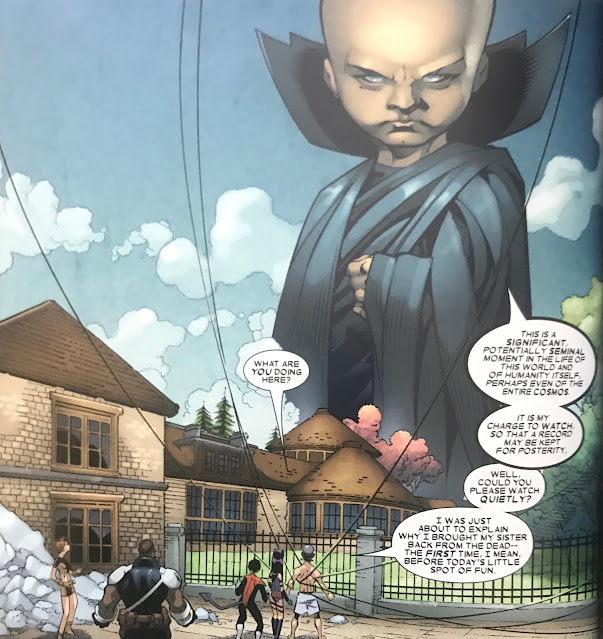
The next arc also has nothing to do with the Sentinels stationed around the mansion and the X-Men's vulnerability, as if Claremont knew his days were numbered and wasn't going to waste them doing anything more than lip service to continuity. Instead, it has another problem that hurts his X-Men comics: power creep, that the dangers they face become of a scale way too big, too often. Look who appeared, the threat is so dire:

Maybe he shouldn't have played the Uatu card

This last arc is about the inverse of the Phoenix force. Rather than a force of destruction and creation, this is a force of stasis. It's a strange story where reality-shifter Jamie Braddock isn't invincible, and the X-Men are zapped to an Egyptian-looking place where their powers are neutralized and aliens live in peace. 

Roger Cruz does decent work; not my favorite, but pretty good
When you bring the Watcher in to announce a story, it should be epic, and this story isn't. It actually feels pretty small because not much power is displayed. 

The volume is closed with a story about Storm in Africa which might be a spiritual successor to  Life DeathStorm is stopping a child-kidnapping African warlord, and the X-Men come to offer backup. Storm is hurt and has multiple hallucinations of her experience with different people she cares for. Unfortunately, it has weak art. It's drawn competently, but lacks the flair or emotion to carry the story.

That looks like art from a DC book

If it sounds like I'm beating on the book, I guess I am. I read it quickly enough so I was enjoying it. But other than the story with compressed time in it, none of it really stuck in my memory.  It was a fizzle. If Claremont had been writing this same stuff in 1989, it would have sunk in a lot more, but in comparison with what else was going on in the era, these aren't exceptional comics.

As this was finishing at the time, Ed Brubaker was delivering Deadly Genesis, a comic which was certainly memorable, though more infamous than beloved. His X-Men run starts the issue after this book ends with a 12 part space adventure which I enjoyed a lot. It felt fresh because he was dipping into the X-Men for the first time. In comparison, Claremont was doing what came naturally to him with his run, but after a lifetime reading his original 17-year run repeatedly, it's almost like a new Rolling Stones song. It's them, it's alright, but it just isn't hitting as hard as the old stuff did.

Tuesday, February 9, 2021

Reading Through 2021 22: X-Men Reload Volume 1 by Chris Claremont and Alan Davis

 X-Men Reload Volume 1 by Chris Claremont and Alan Davis and others

2000s, collected in 2018

Is this series remembered well by people who didn't grow up with Chris Claremont X-Men? It was a weird time for X-Men to try to go retro. 


I don't remember Alan Davis drawing women's necks so long

In the mid-2000s, I started getting back into mainstream comics, and I read a trade of the first six issues of this, issues 444-449, and it was okay, but I'd just read Brubaker's Captain America and the Grant Morrison New X-Men run. Whedon's Astonishing X-Men may have been coming out at that time as well. Alan Davis is one of my favorite mainstream pencillers, so I was expecting to love the book, but I just didn't. In comparison to those other books, there just didn't seem to be much going on in these issues, and I never read beyond issue 449 of UXM until Brubaker took over writing duties.

Recently, this collection of 444-461 was at a discount, so I decided to give it another shot. Over a decade had passed, and I've been reading a lot more older comics, so I just had very different expectations going in.

You get the feeling Davis could draw these characters from any angle

And I liked it better! There were some problems with it, some major problems, but on the whole, it was enjoyable to read. The thing is, it still wasn't great, so I don't know that its high points made up for the lows.

I want to start with the praise: Alan Davis kills it. Every page has love and attention to detail. Claremont's strong point is character work, and Davis draws every emotion on everyone's face. Davis might be the guy most capable of realizing Claremont's talent. I especially enjoyed the conversations between characters, the smiles and the facial expressions. Davis can draw action well too, but it's not where he shines. He's given all different locations to draw as well, and each come out fully realized. It's exceptional work.

That's a ridiculously well-rendered night club

Claremont does do great character work... with Davis. His work with other artists falls flatter. They try, but that's just not what they're good at, and it can be hard to look at. Davis draws most of the book, but three other artists draw short 2-3 issue arcs between Davis' longer arcs and they all suffer in comparison.

I had remembered Claremont's writing in this as being too wordy, and it really isn't. Narration is limited to a point of view character, and isn't too obtrusive. I actually liked the pace of these stories quite a lot. Breezier than the 80s, and meatier than most modern books.

That's the main stuff I liked and I enjoyed it a great amount. I was buying Claremont and Davis Excalibur off the stands, and it's pleasurable to see them write and draw characters they both seem to have enormous affection for.

The bad stuff though...

This is the worst looking page I saw in a Marvel comic in quite some time

As I wrote, the other artists just aren't up to the task. It's not bad work, but it's pretty bland. 

And Claremont isn't giving them gold to work with either. In four of six arcs, the X-Men lose their powers, and two of those times it's because of nanites. I just shrugged my shoulders and powered ahead. 

The villains aren't what pretty much anyone wants to see. The first story has the Fury from the old Captain Britain comics, followed by the Viper taking over Murderworld from Arcade, a mutant mafioso named Geech, Sebastian Shaw, and finally some evolved dinosaurs in the Savageland and the Savage Land Mutates! Nobody likes the Savage Land Mutates, do they? But Claremont keeps bringing them back. It's like the book is a nostalgia series for Claremont himself, the things he misses writing. I suppose he should be writing stuff he's passionate about, but sometimes...

Claremont is forced to juggle a lot of continuity in this. He brings Psylocke back from the dead, Colossus is brought back from the dead in Astonishing, Jean Grey is killed off in adjective-less X-Men, Wolverine goes rogue in his own title, and I think X-23 is brought in from somewhere else. I don't know if he chose to deal with it all or if the editor forced him to reconcile all this continuity, but he ends up doing it. It is a noble effort, but, as a reader, that's a lot of other titles you're forced to discern the happenings of. And at the end, House of M is teased, so it is only going to get worse in the next collection.  

Finally, he loves Sage. I kind of know who Sage is, she's been used a bit in the current HoX/PoX run, but she is Claremont's Poochie here. When she's not the center of the story, other characters are talking about her and trying to figure out what she's doing. And at the end, I had no real idea of who she was, and wasn't interested in it either. Her use was a prime example of tell, don't show.

Nobody was asking for this

The other disappointment in this was the use of Psylocke and Captain Britain's brother Jamie Braddock as a subplot, which would seem to be resolved in the next collection. I think he's as uninteresting a character as it gets: a malicious reality warper that generally treats characters as playthings. In a series with a roster of villains like Mr. Sinister or that Shadow King, Jamie 
Braddock just isn't bringing much to the table.

I enjoyed reading the book overall, because I enjoy the experience of Claremont and Davis doing X-Men so much, but it's not a great book, and I probably would never recommend it to anyone not already partial to the X-Men. Now to see how much that second collection currently is selling for. I can't stop myself.

Friday, January 29, 2021

Reading through 2021 13: Uncanny X-Men Omnibus 2, by Chris Claremont, John Byrne, Dave Cockrum and many more

Uncanny X-Men Omnibus 2, by Chris Claremont, John Byrne, Dave Cockrum and many more

c.1980, printed in 2020


I could write about ten different essays about this book, so I'm trying to boil it down to essential ideas and not just my nostalgia from reading and rereading these in the mid-80s.
Before X-Men was a movie, before it was a cartoon, before it was product line at Marvel, it was just a minor title with creative freedom. Chris Claremont was the writer of the book for 17 years as it became a juggernaut. Rereading these now, I learned a lot about his writing.


The first half of this is one of the most acclaimed Marvel stories ever, the Dark Phoenix Saga, written by Claremont, drawn by Byrne, and plotted by the both of them together. Byrne later used to joke that if Claremont was writing by himself, it would have just been conversations between characters. Byrne would have major creative differences with Claremont and abruptly leave the book to write and draw Fantastic Four, and if I compare those two books, there is a lot of crossover. Byrne is fun, but he's a "hard sci-fi" guy, he wants to pretend his space aliens have some basis in reality. His run of X-Men shows that.

Then he leaves the book, Dave Cockrum comes on as penciler, and man, the book gets ridiculous. Doctor Doom encases Storm in an organic metal shell and she subconsciously causes the biggest hurricane ever. Cyclops is in the Bermuda Triangle and ship wrecks on an island that just happens to be next to the ancient island Magneto raises from the sea floor to be his new base. The White Queen zaps Storm with a Personality Exchange Gun which swaps their bodies. In the Marvel Fanfare issues included, the Savage Land Mutates use a de-evolving ray to reverse the effects of evolution, turning Spider-Man into a giant spider. Claremont was dead serious about characterization, but at this point, his plots aren't so far off from when he had Wolverine tussle with leprechauns around issue 97.

But then, within this, he uses these ridiculous plots as places to hang incredible character beats. Probably the best is having Magneto take down a fourteen-year-old Kitty Pryde. Looking at her body, he realizes that he's completely lost his way and is becoming the kind of person he claimed to be fighting against. It's pulp storytelling, but Claremont goes on to develop the story for the next four years, as Magneto tries to become a better man and eventually takes over for Xavier. This is essentially what all the X-Men under Claremont did: They saw their own faults, and looked at the other members, even the ones they didn't like, and had respect for them, and used them to be better people. And when they didn't, the other members were there to encourage them to be their best. This isn't what was going on in other team books of the time.

This is a super hero comic ostensibly for kids. Look at that art!

My favorite story in the book exemplifies the amazing character work among the ridiculousness: a short story about Jean Grey's sister Sara remembering an adventure together with her. At Jean's grave, Sara Grey thinks about how much she misses Jean, and remembers when she learned Jean was a mutant. The two were having a day sailing, and Sara thinks about how she was then less comfortable around Jean having learned that Jean is a mutant. She worried that if Jean was a mutant, then possibly her kids could be mutants too. (this is a very clear "coming out" metaphor) Then their sailboat is attacked by Attuma of Atlantis, who brings them to his undersea kingdom and changes them to blue water breathers in order to be his new brides. Absolutely stupid story, and it wasn't a favorite of mine at the time. But then the final page, Sara talks to Jean's grave, and thinks about how different she feels now. She misses her sister, and realizes that she wouldn't care one bit if either of her children were mutants, she only hopes they can grow up to be half the people her sister was. It's such a potent, honest expression on how people can get divided from the people they love due to prejudice and hate, but at the end of the day, (hopefully) it's love and respect that will be the legacy of the relationship. Incredible emotion, well-told, in a story about Attuma using Atlantean technology to capture human brides.

A particularly touching letter

The book also includes letter pages, and they're very interesting, especially the ones written by people who take the book to heart. It really was trying to capture emotions that other books of the time had no interest in. For folks who felt like they couldn't be seen, this book gave them hope.
I enjoyed reading this so much. I still read some new X-Men comics, but after reading this, I'm well-aware of why I loved this group so much, and how much was lost when it simply became a franchise.