The Interview, by Manuele Fior
2013, English edition 2017
I had originally meant to stop at 100 entries in this blog, and as I prepared my 100th in May, a sprawling look at Uncanny X-Men Omnibus 3, I suffered extreme disillusion. The Internet is extremely disillusioning. I realized that people clicked through on reviews mainly on things they'd already read or had interest in, and mainly commented to express a disagreement. I think the saddest thing was posting some reviews on Reddit, and one time having negative votes. For posting a review. As if what American comics needed was fewer people thinking about, writing about, and caring about comics.
I've continued to think about and care about comics, but not write about them. I'm sure I've read another 100 books in the last four months. The previous books in this blog feel like a year ago, not months. But I still do want to talk about and share the comics I read, especially the work that hasn't gotten the attention it should.
In April, I read 5,000 km per second by Italian artist Manuele Fior. It was beautiful, emotional, and really exciting. It wasn't entertaining, or of the zeitgeist, nor did it have Batman in it. It was just a good book. I ordered two more of his books, and months later they arrived. I wasn't prepared for just how good and how different the first one I read would be.
 |
| Weird sexuality is a theme of the book |
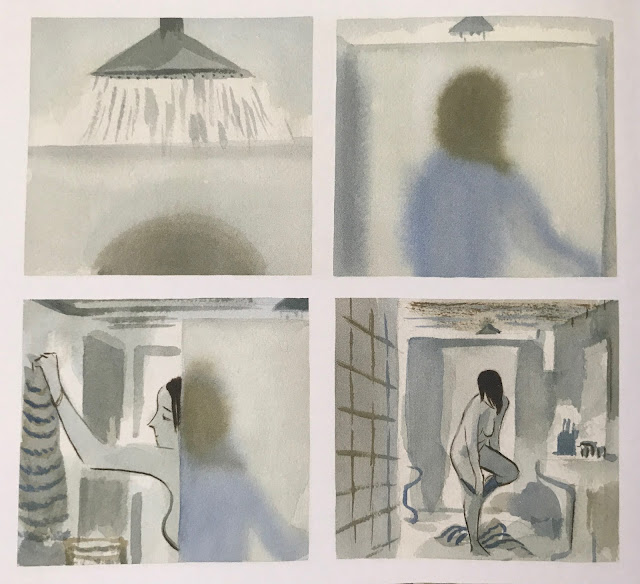
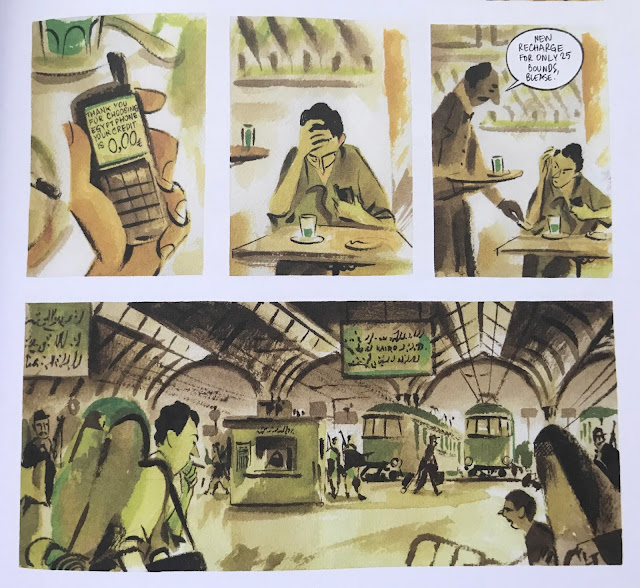
The first thing I noticed about it was that, while graphically in line with 5,000, he really was working a different part of his skillset with this. 5,000 was done in loose watercolors, with shifts in color palette throughout the book to match shifts in time and space. Here, he works in ink, both chunky brush and precise nib work. He uses something to texture the pages. Sometimes it's a gray wash, sometimes it's a pencil-like texture. His illustrations are, at their core, cartoony, but the pages carry a photographic weight in many places.
 |
| The book has a unique atmosphere, never exactly realistic, but with very natural structure underlying the images |
Like 5,000, it's a mild sci-fi. The story takes place in 2048, but it's very recognizable as our world. Some youth fashion shows it's in the future, and most of the cars are self-driven (part of an early plot point has the middle-class protagonist driving his own car as a luxurious indulgence), but for the most part, this is our world. In
5,000, the story takes place over a few decades, so it was clear why the later half would go into the future. Here, the future setting isn't so important other than it gives Fior space to play with youth movements and how the older generations have difficulty grasping them.
 |
| This was the first real virtuoso page in the book. The movement on display with his hair and broken glass flying conveys the scene perfectly, with even the camera angle seeming to rock from left to right. It feels like being in a car accident |
The book has two intertwined plot threads: The protagonist, a psychologist named Raniero, has a car accident late at night after a UFO sighting. This is haunting to him, as he knows it's 'crazy', but he also trusts himself enough to trust his experience. This happens as he's in the midst of separating from his wife.
The second thread involves a young patient named Dora he starts seeing, who has been admitted by her parents. She's a part of The New Convention, a youth movement that is against monogamy and traditional family structure. Immediately there is some connection between them as she doesn't feel she needs psychiatric assistance at all, and is only there because her parents can't understand her point of view. The two of them have their views of the world rubbing up against the conventional understanding of life.
 |
| If this were a modern American mainstream book, the artist would have simply copy-pasted the illustrations. Fior animates his characters from panel to panel, breathing life into them. |
From there, there is some inevitability that they will sleep together, as dual protagonists in a story, but also that they have established an emotional connection. But that isn't the story. I'd be hard-pressed to say what the story actually is. It's a series of emotional shifts as two people with unstable lives navigate the world, a world that pushes against their own personal realities.
I haven't watched them in decades, but I greatly enjoyed the 60's New Wave films of Jean-Luc Godard when I was in my twenties. There was barely a story, just emotional truths and gorgeous images. This book has a lot of that. In the wrong hands, this book will be extremely boring. This book is much closer to 'art' than to entertainment. I have a lot of entertainment books, not a lot of 'art' books, which is probably why this resonated so strongly with me. I'm hungry for work like this.
While the art has a feeling of cartooned realism like the best of Disney movies, a sex scene is interrupted by a nude panel that is borderline photographic except for Dora's face. It stops you in its tracks, and likely that is the emotion Raniero himself is feeling as his world stops and he takes in the body in front of him.
 |
| I have no idea of the techniques going on here |
Fior has violence trickle through the book as well, that casts a shadow over the rest of "normal" life.
 |
| Fior's storytelling is fluent, if I had to choose one word |
Fior balances down to earth talky scenes with panoramic scenery, and spurts of sex and violence. It's about the glacial shifts of emotion people go through in their lives. People change slowly, but they still decidedly change.
At the end of the book, I was wondering just what I had read. It was not a story in a conventional sense. But I loved it. It had resonance. I thought about it for days after and opened it up again to look at the art a few times. It's a short list of books that come off the shelf so soon after they go up.
 |
| Young people, ugh |
I was taken by the body language, the facial expressions, the lighting, the architecture. Fior is a comic artist at heart, but he's working in a school of art far outside of what I'm accustomed to. I've been reading alternative comics for decades now, through Raw, Drawn & Quarterly, Fantagraphics, L'Association, and so on, and while I've often seen masterclass work through those venues, I don't see so much these days where the artist is staking out new territory like Fior seems to.  |
| Once you see what you're looking at, this is a pretty incredible two panel sequence |
I have one more Fior book on the pile, and I'm just going to have to order the others Fantagraphics have made available. I don't know if they'll all be as exquisite as this, but they have to be worth the read.