Showing posts with label crime. Show all posts

Thursday, May 6, 2021

Reading Through 2021 90: The Last Days of American Crime, by Rick Remender and Greg Tocchini

The Last Days of American Crime, by Rick Remender and Greg Tocchini

2009, Image collection 2017

Sometimes you get it in your head that you like a writer, and it takes a number of books to realize you don't like them that much.

It's a good cover
I first read Remender's work with his X-Force run way back when, and I liked it a lot. Since then, he's been a writer I liked, but I don't think I've loved his work since then. I've written about Fear Agent here, which was fun, but not incredible, but I've had similar experiences with Tokyo Ghost, Deadly Class, and I don't remember what else. Up to now, Low has been my favorite work by him, which shares the same artist as this, Greg Tocchini.
The skin tones are bold enough to support the sketchy linework
I like Sean Murphy and Wes Craig's art a lot. Sean Murphy single-handedly made Tokyo Ghost a marvel to read. But Greg Tocchini does something which really hits me in a way most genre artists don't: I love his lighting. The layouts are fine, the character designs are fine, but he's so adept at taking the lighting of a room and getting the flesh colors just right, the shadows just right, and building up an atmosphere. I have to wonder what Low would be if he weren't illustrating it.

Tocchini is quite good at doing a sensual brush stroke

Here, he's applying his skills to crime rather than sci-fi. Going in, I thought it might be a noir, and in construction it is, but so much of the book is drenched in light that it loses that vibe. The book has a distinctly California feel from the motels, the blue skies, the sunsets, and the multicultural racism.

The vision of police swarming American cities is less and less far-fetched everyday
The book collects three oversized issues to make up a single story. A ex-con hooks up with a pathological couple to complete a heist on the final day of American crime. The overarching shadow over the story is that crime is rampant, and the government will begin broadcasting a signal that will psychologically prevent people from breaking the law. The heist will happen on the eve of the broadcast. 
These are Bad Dudes
As a story, there isn't that much there. The ex-con meets the couple, they get ready, then they do the heist, with an ultra-violent interlude in the second issue. I don't mind that overall; plots tend to disappoint the more they are relied on. The first issue of this was the most enjoyable for me. The ex-con, Graham, is established as someone barely keeping his nose clean, and with scores he wants to settle. The femme fatale of the story, Shelby, is less mysterious than in your typical noir: right up front you see that she is playing all sides and is a main character rather than someone who pops in and out to tempt the lead. She has all but given up on humanity, and Graham's bottomline decency affects her.  Sure, Graham will sleep with her in an instant, but he also won't let her get beat up and raped. That's decency in this world.
Again, Tocchini's killing it with the lighting
That might not sound like much, but they are clearly characterized, and not stock stereotypes. The third in the heist, Kevin, is much more of a stock character, and one that Remender seems compelled to put into all his work: the psychopath. He had a rich, scumbag daddy, and now Kevin is a rich, scumbag young man. That's the first major strike I have against Remender's writing, that he wants to write like it's mature, but he also wants a black-and-white plainly evil character in his books. It's a very Quentin-Tarantino school of plot design. And I'm not against the psychopath archetype, just not in every book, as it seems to be with Remender's creator-owned work (I don't recall a psychopath in X-Force, but it's been a while).
This is a Robocop 2-level of urban decay
The second issue is the weak point for me. It feels like filler. It tries to be splashy, but it was trying too hard for my tastes. Graham goes up against a Latino gang, with lots of racism, rape, and car chases. I'll compare it here to Brubaker and Philips' Criminal or Lapham's Stray Bullets, where they would have the same thing, but it's upsetting and stressful. Here, it's much more of a "Fuck yeah!" version of racism, rape, and car chases. I enjoy crime books where the guns and exploding heads are horrifying much more than where it's awesome. I can enjoy exploding heads in a book which is going for over the top, but that's not the tone of the first issue. I guess the problem for me was that the tone was inconsistent. It shifted between a moody, atmospheric crime story and a bombastic violent farce.
Everybody hates everybody
In the end, they do the heist, many more people die, and the book ends. The sci-fi idea of the mind-altering broadcast is barely touched on, though it comes in at the end to tie up the story. It's a shame, because other than a talking head on TV at the start, the book never really considers what that would do to a society. There would be no crime, but people would lose the choice to be good, like with the Ludovico Technique in A Clockwork Orange. Only here, people would be reliant on the law to decide what is acceptable. Lawmakers could abuse this by rewriting the laws and the populace would be helpless. Normalcy and patriotism could effectively be made law. There were a lot of ideas just left on the table here.
This was the point I dropped out. It wasn't exciting, it killed the mood that had been building
Overall, I liked this for the art. The story was fine, but not exceptional. The art carried it. That seems to be a common thread for creator-owned work these days. Produce a competent story with a few conceptual hooks behind it, and get one of the many super-talented working artists to illustrate it and share copyright for it. Nothing exceptional.  

Remender and Tocchini got this made into a Netflix movie last year and got paid, and that alone would make it worth their time to produce this.

Wednesday, March 31, 2021

One Coin Reads 20: Curtain Call, by Lugano and Rodguen

 Curtain Call, by Wilfred Lugano and Rodguen

2013, English edition 2018

I went in to this book with no expectations, and finished it with a tear leaving my eye.

The cover fits the content of the book, but maybe the first impression was misleading 

One of the great discoveries of my bargain book purchases has been Lion Forge's Magnetic Collection of books. Before buying these books, I had never heard the name Magnetic Collection that I could remember, despite having a volume of their excellent Toppi collections. I just glossed over the publisher label on that one, I have too much information hitting me every day to have it all sink in. 

Once I got a few books though, their name stuck and I realized a few things about them:
-They are putting out some great translated works.
-They must be having difficulty getting their name out their consistently.

I'm not in the shops or at the shows, so maybe they are having better luck in the real world. So much of my experience of what's happening in comics is through the Internet, so I'm not an accurate barometer.

Vincent is the smarter one, Gaby the dumber one
Anyway, Curtain Call was a mere ¥491, not a difficult chance to take. At a quick preview, it looked to have animation style art and coloring, and I wondered if it would be a turn off when reading, but my eyes adjusted to it almost immediately. Rodguen was a Dreamworks animator for 15 years according to his bio, and his illustrations and character designs are full of life. I don't think there was a confusing or awkward drawing in the whole book.

The story is about a screw-up named Vincent who has a plan to rob an armored truck and get out of France, and start over. While the main story is fairly linear, there are a lot of flashbacks for Vincent and other characters to show their background and give an understanding of where they're coming from. It's all narrated from Vincent's point of view, giving the story a conversational feel and a natural flow.
Vincent's home life is fine. It's not great, not terrible. Maybe people can relate to this?

Early on, we see a twist in the heist of the story: Vincent wants to do an ethical heist. He's convinced that he has a way to pull it off where nobody will be hurt and all the people directly involved will be better off. Then the story leads to a climax with the heist, taking lots of turns that all manage to feel organic.

The plan

What's so good about this book is that Vincent is very real character. Writer Wilfred Lupano places him in a realistic setting where Vincent realizes he doesn't have a great upbringing or foundation, but he still has a much better one than so many of the people around him. Vincent isn't a good guy, but he wants to be better, he really wants to change who he is.

The story isn't overly political or about racial politics, but a lot of Vincent's spiritual awakening happens during a trip to Senegal, and the politics of race in France are an undercurrent. Vincent's partner Gaby is a homophobic racist and displays other negative qualities, but he manages to be portrayed in a sympathetic light while showing that he doesn't even understand what he's saying or why he thinks what he does (for example, he calls anyone brown a raghead, not understanding that the slur is aimed at a specific group). It's a clear contrast to the Manquette/Tardi book I read last week where I had difficultly separating the character's racism from the writer's racism. Here, I clearly can tell the writer is using to illustrate the character. 
Gaby is terrible at telling people off because he's just not that smart

Overall, I was just impressed with this book and closed it with a smile on my face. It wasn't predictable, but when it was over the arc of story made sense. By the end, I could see that the story was revealed with precision to get the maximum effect, but nothing felt like a writer's cheat, like information was withheld to create tension. The story unfolded in a naturally as Vincent, the character, would tell it.
The coloring by Ohazar is great. Lively and clear

And yeah, I had a tear in my eye at the end. The book has people who do bad things or stupid things, but it doesn't really have bad guys you're rooting against (at least not for more than a page or two). By the end, you just want everyone to be okay. 

I want to read more books where you like everyone.

Tuesday, March 23, 2021

I Really Should Read This 19: Streets of Paris, Streets of Murder 1, by Manchette and Tardi

Streets of Paris, Streets of Murder 1, by Manchette and Tardi

1978, 2005, 1980, collected edition published in 2020

Now I have a new artist to buy everything from: Tardi.


I ordered this two-book slipcase Tardi collection in November, and had given up hope on it arriving. It was released in November, so I should have had it shortly after it came out, but it arrived last week, some five months later. 

Why did I buy it, other than the fact that I've been buying too much since I stopped going out due to a pandemic? The past year I've been filling in holes in my reading, and I figured I should know some Tardi. I've even read some in my life. I saw his work in RAW 25 years ago, and though it looked good, it didn't make a huge impression on me back then. I just felt like reading it though. The noir vibe was something I was in the mood for. And this book blew me away.

No, not like that

It collects three works authored by a French novelist, Jean-Patrick Manchette, and drawn by Tardi: Griffu, a detective story from 1978; West Coast Blues, a detective story without a detective from 2005; and Fatale, an unfinished story from 1980.

Just opening to the first pages, I was in love with how he rendered the city.
That car with one side over the curb in the second panel... it's stuff like that that gets me
His art manages a trick of that Disney animation can do so well: it's real without being realistic at all. There is a weight and mass to everything, but it is not rendered in an illusionary way. It's just ink on a page. I went through Griffu loving the art, and was surprised to see 
West Coast Blues appear in stark black and white, no grays. At first, I was thinking that the later work might be weaker in its illustration, looser, that the 25 years between the two stories had worn him down a little, but no, it's just different. Probably he spent a little less time with a ruler in the second story, but it's a masterfully drawn work.

Showing off by drawing three completely different car models

Griffu was a good story. Not incredible. I'm not a noir super fan, but I'm aware of the genre, and this is the sort of story like the Big Sleep or the Long Goodbye, where the detective bounces around the city getting little sleep, barely figuring out what is happening, and getting a lot of bruises.
Not such a nice lead character
It's written by an older established writer in 1980, so there are a lot of little racist nods in the story (for example, Griffu continues to call the hotel clerk Mohammed after the clerk corrects him that his name is Rasak). As a reader in 2021, I try to figure out if the writer is writing a character that is racist, if the writer is being racist himself, or if France in that period was, and I can't figure that out, and it's probably a bit of each. It's too much for me to dissect. It wasn't overwhelming anyway, just noticeably not something we'd likely see today. It did make me think about whether the hero of a story needs to be a "good guy." Griffu is not quite a good guy. I'd have a hard time even pinning down his motivation by the end of the story.
That first thought balloon made me laugh out loud

It's a winding story with a dark ending, and it was good, but I liked the art more than the story. It was a good story with great art.

That's a big phone. The panel layouts in this are gold. Bold, clear images bathed in shadow

The second story though, wow, it is flawless. I was riveted from start to finish, and it was about something. A frustrated man is out driving one night and rescues another man from a car accident. That man had been in an assassination attempt and the killers are sent to clean up the rescuer afterward. That's it, a story of a Good Samaritan being punished. The story spins away from there, without a clean, straight-forward plot. It goes unexpected places and has a strange resolution which works as a pulp story but works as something more introspective as well.

After, I thought about my own boring life. It was a great 80-page story. It's amazing what a writer can do with a limited number of pages. 

The rest of the book is a 21-page story called Fatale, that was originally going to be 60 pages. It sounds like an unsatisfying read, but those 21 pages are all set up. While there is no resolution, it ends up reading more like a character sketch than the first chapter of a book. And it has one of the more striking images I've seen in a comic in a while.
A happy person wouldn't do this
With the Ed Brubaker Criminal books, the Parker series, Stray Bullets and this, I think I am a noir fan. Either that or I'm just lucky to stick to the finer stories.

I have the second book of this waiting to go. I'm going to give it a few weeks so that it can all sink in better, but I'm excited to read it. And I'll have to start in on his World War I books after that. This is an expensive hobby.

Sunday, March 7, 2021

I Really Should Read This 14: Stray Bullets: Sunshine & Roses 1 "Kretchmeyer", by David Lapham

Stray Bullets: Sunshine & Roses 1 "Kretchmeyer", by David Lapham

2018

Of all the books I discovered during The COVID Year, Stray Bullets was the biggest surprise. I had heard of it for a long time, but one thing kept me away: the name David Lapham. He was the artist for one of the worst comics of the 1990s, Warriors of Plasm. That fact alone kept me from even reading a news blurb about his self-published book, Stray Bullets. It wasn't until I participated in a comic reading club last year that I gave it a chance, and I really liked it.


At this point, I love it.

Lapham, with help from his wife, have produced ten trades worth of Stray Bullets over the years, broken down into two runs with a long break in between. It tells the interconnected stories of low level criminals and the people orbiting them, mostly in Baltimore, mostly in the 1980s. But Lapham shifts periods and the characters move around in the course of their lives, so 1980s Baltimore is the base of the story more than an exact setting. It follows an ensemble of characters tied together by their relationship to an unseen crime boss named Harry. Some work for him, some date him, some are friends of those people, but Harry is a kind of invisible glue connecting all these pieces.

Kretchmeyer is the start of the second run of books. Pretty quickly you can place Kretchmeyer as occurring between the first collection, The Innocence of Nihilism and the second, Somewhere Out West. When I read those two books, there was a story gap between those two, with characters relationships having changed. It's interesting to see Lapham go back and flesh out those changes. The Innocence of Nihilism had a lot of time shifting, between the 1970s and the 1990s, so from the start, Lapham has set down various key points for characters, and then does a lot of exploration in between those points as volumes continued. It's a novel story concept, and he's now thousands of pages in.

Beth is not a role model

As I read these books, I'm amazed how well-delineated each character is. Lapham draws each character differently, of course, but the range of choices each character makes always fits or redefines their character. There is no one protagonist, but Beth is the closest to a lead character. She has some relationship with most other characters that appear. Lapham spends a lot of time with her, and makes her a complicated character. She's protective of her friends, but also quite callous. She's very street smart, but has impulse issues as well. One of the coolest details of the book is that Lapham gives her a character tick, like a movie actor might use. Beth often brushes her hair behind her ear. It's possible that Lapham has an idea of when she does it, like when she's tense or anxious, and I didn't go out of the way to try to figure it out, but it was interesting just to note how much she does it. It's a detail I've never noticed in a comic before. Lapham is treating her like a breathing person.

Rose is barking up the wrong tree

The other characters probably don't have quite the depth in their portrayal as Beth does, but they are still very well rounded. Beth's boyfriend Orson is a sad boy; a good, repressed high school graduate who is addicted to Beth. You could write an essay on his portrayal: he's an active protagonist in a self-destructive way, abandoning his bright future for a woman that thrills him. Beth likes him, and he seems to bring out a better side of her, but she's more possessive of him than loyal to him. He's having the time of his life with her though, so there's no chance he'll get away from her.

C'mon Orson

Another characters that gets featured in this volume is Rose, a prostitute who is probably a textbook-definition of nymphomanic. She's fairly well-intentioned and wants to be a good mother to her latchkey son, but she isn't a good person nor a good mother. It's heart-breaking to watch, especially her interactions with her son Joey. Joey never really stands a chance in this world.

The most surprising story in the book showed the life of Monster, one of Lapham's scariest characters. Up to now, Monster was referred to, and he showed up to break bones, but he wasn't someone who got a lot of characterization. He is the strong silent type. In his story, you see flashbacks to his childhood with Beth, and his home life. He's a scary guy.

At home with Monster
The Kretchmeyer of the title is a new guy who comes to town and wants to make a name for himself. He's handsome and charming enough, but he has a lot of menace bubbling just below the surface. There are three main "thug" characters in this book, Spanish Scott, Monster, and Kretchmeyer. Spanish Scott is tough and will hurt a person, but he's also friendly and looking for a good time. Monster isn't interested in fun, but does the job he's paid to do. Kretchmeyer meditates and keeps his cool, but gives off genuine psychopath vibes. Everything he does is in order to get something else. He made me feel uneasy.

Kretchmeyer probably thinks he's more evolved than other thugs

All in all, it was a thrilling, if dark, read. There are eight issues collected, and though there is a general overarching plot, each issue has its own self-contained arc. Because of this, the book is genuinely unpredictable and reading another issue is exciting rather than a countdown to a resolution. 

Lapham is a detail-oriented artist, who works mostly in an eight-panel grid. As a result, the emphasis is on telling and showing the story. It's so easy to get sucked into this world. I have three more volumes of Sunshine and Roses left to read and I'm excited to read them!

Tuesday, March 2, 2021

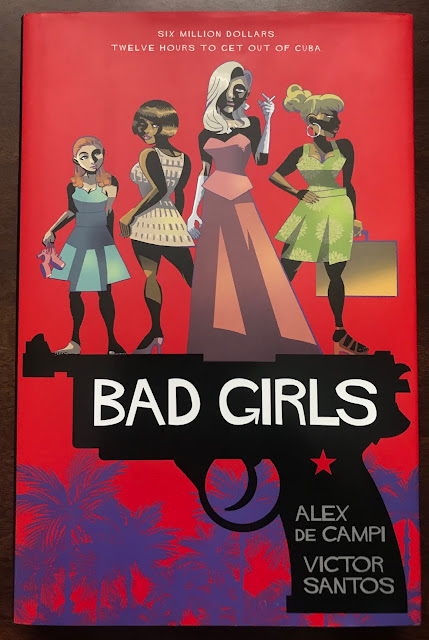
One Coin Reads 9: Bad Girls, by Alex de Campi and Victor Santos

Bad Girls, by Alex de Campi and Victor Santos

2018

I try to get out of my comfort zone with comics these days, just because sometimes I'm really surprised with what I enjoy. It's a reason to throw down some cash on cheap book, just to see what it's about. Sometimes I really like it, and sometimes it's Bad Girls by Alex de Campi and Victor Santos.


It was only ¥438, so it cost me more in time spent reading it than in hours worked to pay for it. Up front, this isn't egregiously bad or anything. I'm not angry about it. My take away from it was likely influenced by its presentation. This is a nice hardcover book with beautiful paper and the support of an international publisher. It is being sold as a "good" comic, not one of those disposable leaflets on the rack. So I just expected something better. I've read comics of equal quality in poor packages which I enjoyed more simply because they embrace their low class roots. What this book reminded me of was when HBO and other cable outlets were making great serious dramas in the 00's, and networks tried to copy them by making more mature works. But the network shows were always weak, and felt like they were trying to be something special rather than just being something special. This is like a network drama trying to be a cable drama.

I like the colors, but somehow I don't like the coloring

With this book, you have a dramatic setting, Cuba on the eve of the revolution; interesting characters, three women of different social statuses and ethnicities linked by their workplace at a mafia nightclub; and strong motives for all to take the money they have access to and get out. It's all competently written, but it's not surprising. There's an affair, a mafia boss who's got a bad temper, feisty burlesque dancers. I know something could be done with this set up, but de Campi seems content to let it play out as expected. 

I thought the characters were pretty simple. They had their goals, and didn't stray from them. I wonder if it were drawn by another artist whether or not it would get more out of the characterization.

The book veers into noir, a page like this would read better without the lyrics. It makes sense as a concept, but in execution it's awkward

The artist, Santos, is competent, and is coloring his own work, but I found it to be sterile. I love the work of Bruce Timm and Darwyn Cooke, and Santos seems to be a fan as well. But Timm and Cooke have a lot of life in their lines. Santos has controlled lines that lack their spark. It could be the digital panel work, or the song lyrics digitally imposed through a lot of the book. The polish on the pages took away from the feeling. I would have enjoyed the book more if it were more stripped down graphically.


Whatever the reason, I just didn't get into this book. It was very competent, but not memorable. Some people might really get a kick out of it. If you like the setting of Havana in 1959, it might be worth a read just for that. But there are already too many good crime comics not getting the deluxe book treatment for me to spend more time on this book.

<Edit> I just checked Amazon to see the page count on this, 224 pages, and saw that this was nominated for three Eisner Awards. Ugh. The more a book like this is put on a pedestal, the less interesting it gets.

Wednesday, February 3, 2021

I Really Should Read This 6: Parker, The Outfit, by Darwyn Cooke

Parker, The Outfit, by Darwyn Cooke

2010

I've read and enjoyed some of Cooke's work, but I haven't put much effort into getting a hold of it. The number one reason is DC is generally uninteresting to me, and that's where a lot of his work has appeared. Last summer, I decided to try out his Parker series, and after reading the first one, I promptly ordered the second (and third and fourth after that, just because I realized I wanted to have them).


The first Parker book took me off guard. I knew nothing about it other than it was based on a series of novels. The main character is not a good guy. He kills people. He's not a killer, he's just a thief, but when he needs to, he kills people. Once I adjusted to the notion that it was an anti-hero story, I was totally with it.

This is why I'm only buying the hardcover versions.

The story in this, and in the first book, are good. They are classic hard-boiled tough guy tales with manly men, sniveling men, stunning women, bad choices, and lots of money. As a genre, it's not my cup of tea, but when it's done at the top of its game, like in the Soderbergh Oceans 11 film or in Ed Brubaker and Sean Philips' Criminal series, it's great. 

And it's great here. Cooke was known as a storyteller, and he's completely stripped down to the essentials here. None of this computer-gradient skylines or sterile lettering. This is him and his brushes and Rapidographs (I'm guessing), and two tones of ink. It's completely refined, but it feels a little punk at the same time.


The wordless sequences sing. You follow the action intuitively. The pages with lots of dialogue can't be equally intuitive, but he shifts angles and lets the characters "act" enough to never let it become talking heads. This was Cooke at the height of his powers.

I don't even know the style he's referencing here, like a 1950's Esquire?

There's a weird break in the book about halfway through, where he does a massive stylistic change. I was going with it when it happened, but I wasn't really sure why it was there. When I got to the parts after that, and understood why he was doing that, it was great and 100% I understood what he had done. That's a good experience with a comic. Not merely to be surprised by it, but to get to the end and say, "Ah yeah!" with it. 

"I wasn't asking."

I'm not all that interested to become a Cooke completist. I'm sure his Batman issues are solid, but I just don't care that much. I have the New Frontier, that covers me for DC action books. And I'm not crazy about buying the stuff that's been expensively repackaged after his death.

These Parker books though, I need to get them. The storytelling, the aesthetic... I'd love to add a third aspect, but it's mainly those two things. Cooke was so good at what he did, that that is enough.