Showing posts with label Jack King Kirby. Show all posts

Sunday, November 28, 2021

Reading Through 2021 103: The Eternals by Jack Kirby


 I have decided to keep writing, but I will be posting on a separate blog space, POP: Culture and Comics. 

The logic being that I can manage a little more random traffic on a site already populated by other writers, and on their end, I suppose I write about work that the people there aren't writing about already. 

My first piece is on the Eternals, the original one, not the many many attempts to make them happen.  Click through and read there!

70s art meets 21st century coloring

Kirby's Eternals

Friday, April 9, 2021

One Coin Reads 22: The Kamandi Challenge, by DC

The Kamandi Challenge, by DC

2018

Yet another book I barely bought. While I've been giving DC comics a chance, I really don't like their aesthetic and philosophy overall, and it's been that way for at least 20 years. Some creators at the company are given freedom and make enjoyable work, but the overall tone of their whole publishing line has felt like what a teenager thinks being a grown up is. Grant Morrison manages to stand apart from that, but I've still been turned off of them as a publisher.

This book, the Kamandi Challenge, is a tribute to the 100th anniversary of Jack Kirby's birthday, so they had Jim Lee, a guy who has zero Jack Kirby spark in him, do the cover. It boggles the mind.

Like Kirby, but more "real"!

Why did I buy it? it was ¥6000 marked down to ¥600, so it was kind of daring me to get it. Plus it has a lot of creators I find interesting contributing, so it had to be worth at least the ¥600 it cost, right?

The cover to the first issue by Bruce Timm, a guy who gets why Kirby was exciting

I think it was. First, what the heck is this book? It was a twelve issue series with a different writer and artist (and sometimes colorist) on each issue. The final page of each ends on a cliffhanger that the next team has to solve. And it stars Kamandi, one of Kirby's 70's DC creations. It sounded like a fun project. 

Unfortunately, I have only ever read the first issue of Kamandi, so I don't have a grasp of the world to compare this to what Kirby created, but my understanding of it is that it's Kirby's spin on the Planet of the Apes, a post-apocalyptic world where humanoid animals rule. Beyond that, I don't know the nuances of the character or where the plots went. I'm assuming all the creators here do though, especially older creators like Neal Adams and Walt Simonson.

Mr. Royer's first name is Mike? I get that reference!
It was a fun book! It's a single story of sorts, but it's more like a massive comic jam, where the story is passed along from writer to writer. It's not a very coherent story, but each issue works within itself, and you can tell that the creators are having a good time with it. This comic probably didn't shatter any sales records, but it wouldn't hurt DC to publish more comics where the creators seem to be enjoying the work.

What was most notable was that all the creators involved worked hard to tell an arc in 22 pages. So the pacing is quicker than normal and some subtlety is lost, but it was refreshing to read.

Never having been kissed is a running joke in the book
The biggest surprise for me was that some of the creators in the book I had written off years ago as not to my taste delivered surprisingly good work.

I was pretty stunned at the ability of all these artists to draw animals, including the lemur doctor here from Ivan Reis

I'm not an Ivan Reis fan due to his lack of dynamic energy, and he created much more vibrant pages than I had seen before. 

Jill Thompson, drawing like Jeff Smith

Jill Thompson was an artist who I felt was talented as an illustrator much more than a comic storyteller, and she makes some beautiful pages in this. I hadn't seen new work from her in over 20 years.

Neal Adams takes the action to San Diego Comic Con

Other artists either I wasn't familiar with their work or I wasn't even familiar with their name.  I'd seen Amanda Conner covers before, but was impressed with her cartoony storytelling here. Carlos D'Anda produced some nice psychedelic pages.

Amanda Conner's story has a weird sexy plant woman
Artists I loved as a kid like Neal Adams and Walt Simonson don't fare quite as well, but I don't think their art lends itself well to modern coloring. Simonson especially seems to lose energy with computer shaded coloring. It's certainly drawn as well as ever.

Simonson gets to draw aliens and robots

Dan "I killed Superman" Jurgens does a story as well, and is probably the weakest to me. Unlike Reis or Thompson, I have had no interest in his art and this didn't change that. He's a poor man's Mark Bagley, and I think Bagley draws like a boiled potato. 

The writers are trying to outdo each other with crazy stories, from nuclear bombs to pirates to giant robots to vivisections. None of it is greatly better than each other except Tom King's story with Kevin Eastman of Ninja Turtles fame.

Carlos D'Anda is in harmony with his colorist
King's story is an intimate one, trapped in a room where animals are plucked out by a robot day after day for an unknown reason. It was really good! Unfortunately, it completely ignored the purpose of the book, to play with the cliffhanger the previous writer left. In his case, the previous cliffhanger was a giant sea serpent facing Kamandi. Tom King's story starts in a room (and no sign that it is the serpent's belly either). On top of that, he starts with a philosophy quote and ends it with a Kirby quote, which dispels the narrative disbelief. And it's a good single issue story though! 

It was so fun to see a Kevin Eastman drawn story!

I'm a teacher. Occasionally a student will hand in a good paper that completely ignores the criteria of the assignment, and it's so frustrating. That's what King does here. All the writers are given a text page to express their ideas about the project, and in Greg Pak's, he writes about doing improv, where the idea is "YES, AND". That's what everyone in the book does except King. King said, "whatever" and did what he pleased.

Steve Rude draws the Odyssey with goats

Beyond that weird bump, this book was a nice, easy read. Once an issue was done, the next issue would be a new flavor. 

For the conclusion, they make Kirby a magic god character, and it's fine. I don't know how you wrap up a headless story like this. I get why they want to do it, but I get icky seeing DC pretending to be the Kirby champion. I've got the Kirby-branded DC collections. These days, they want to make it seem like they've always supported Kirby, but it feels like marketing more than it does respect. At the same time, I'm just glad it's all in print.

Kudos to DC for letting Kirby chew on a stogie
Kirby had problems everywhere. Both Marvel and DC treated him poorly, so putting him front and center after he's died feels unauthentic for either company.

What I can say though is that a lot of these creators have a genuine love for Kirby and his work, even the editors at DC, and I can see it. For whatever issues I have with the corporate publishing of DC and the tone of their works, these people do what they do out of a love of comics. We all share the same roots. 

Sunday, March 14, 2021

I Really Should Read This 16: X-Men Epic Collection 1: Children of the Atom by Lee, Kirby, Roth and Thomas

X-Men Epic Collection 1: Children of the Atom by Lee, Kirby, Roth and Thomas

1963-1966

The X-Men debuted in September 1963 and the legend goes that it wasn't very good. It was nearly canceled and barely survived to 1975 when it was rebooted under Len Wein and Chris Claremont with Giant Size X-Men 1, where it then went on to be the number one comic for decades. I am a huge X-Men fan. Not obsessive, but in the 80s and early 90s, I would have been classified as obsessive, and today, X-Men are the single largest block of my comics collection. Yet I've read almost no silver age X-Men except for the brief Neil Adams run in the late 60s. I decided I would change that.


Epic Collection 1 collects issue 1 through 23, and unlike later collections, there are no annuals, crossovers, or miscellaneous appearances. I wish more of these Epic Collections were like this. 

It's hard to see mutants as a parallel for other minorities when they spend half their time fighting "evil" mutants

Right from the start, the stories in this are not great. While some of the villains become legendary characters, there are villains who never came close to being legendary. And the characters are not nearly as well defined as they would be in the Bronze Age comics. Xavier has very poorly defined abilities, shifting from issue to issue. Magneto appears a lot, probably in about 10 of the 23 issues, and though he has magnetic abilities, he can astrally project himself and do other things that future writers would ignore. 

The famous single page where Xavier thinks about being in love with Marvel Girl. It was panel six of a page where all the boys on the team are horny for the single female on the team (except Scott, he's in love)

Of the original five X-Men, Beast stands out most as a character. He's smart and in his free time he writes equations with his feet, which would have been Kirby's joke, but then Stan Lee pulls out the thesaurus to write his loquacious dialogue. It's easy to see the contemporary character's roots here.

Cyclops is a stick in the mud; when the team is given free time, everyone goes out to have fun, and Cyclops stays back to feel sorry for himself. His other main feature is a thought balloon every issue pining over Marvel Girl. 

Marvel Girl's only character is to wish Cyclops would acknowledge her and take her out. 

Iceman is initially defined as a prankster, but in later issues would be shown as Beast's best friend, and gets to play off of their relationship. 

Angel is never really a character, simply a character design. The closest he gets to showing his personality is in his over-confidence in his success. Reading his original appearances, I understand why he was so completely revamped as an angsty bad boy in the 80s. I'm not a big Archangel fan, but he is a better defined character than he was as the Angel.

Cyclops on this page is pure Kirby

Kirby's art here isn't his best. A lot of it feels like 1950s style. Occasionally it pops out and you see the bold blacks, and I love it, but overall, this is not exciting Kirby art. The character design is great though. You get so used to seeing these characters that you forget just how strange it is that the leader of the team shoots red force beams out his eyes. It's a really weird concept.

I just love this image so much

From Pussey! by Dan Clowes 
Beast also stands out from a design standpoint; Kirby really emphasizes the massive feet and toes on him. It's been decided that he will be a blue-furred character from here on in in Marvel continuity, but he's pretty cool without the fur. I think a lot of artists just had difficulty making his feet look as weird as Kirby did. 

Iceman starts out looking like a snowman, much like the Thing starts out as a lumpen rock before being refined into his famous design. In issue 8, snowy Iceman becomes icy Iceman and never goes back. It's interesting to see Kirby evolving his character design.


At first, the stories are focused on mutant themes: finding mutants and fighting mutants. Issues 1 has Magneto, 2 has the Vanisher, 3 has the Blob, and 4 has the Brotherhood of Evil Mutants with Quicksilver, the Scarlet Witch, Toad and Mastermind. That's great initial line up of villains. But Magneto is overused until he his taken off the board with a ridiculous story in issue  11 (A powerful being, The Stranger, is discovered and both the X-Men and Magneto investigate. The Stranger is revealed to be an alien on Earth to collect mutant specimens, and takes Magneto and Toad back to his alien world with him.) Other winners in the early run are Juggernaut and the Sentinels. Kirby created a huge amount of characters, and there are a lot more that stuck around than ones that fell through the cracks. We don't hear much from Unus the Untouchable these days.

Lucifer's boss, Dominus

One of the subplots in the early run is about a space alien, Lucifer, who was responsible for the loss of Xavier's legs. One of the reasons Xavier formed the X-Men was to stop this menace. The character never really works and when Roy Thomas takes over as writer he quickly wraps up this plot, and the character doesn't appear in X-Men again. 

The creators were all feeling their way toward what the X-Men were, and there were naturally going to be some dead ends.

The original Cerebro was quite different

Other trademark X-Men ideas appear in a different form. The Danger Room is there early on, but it is very much like a gymnasium obstacle course, though not too different from what would be in the early Claremont run. Cerebro is nothing like Cerebro I've ever seen. It's a 1960s stereo with names of specific mutants on it. The X-Men of the movies and cartoons didn't spring from nowhere, it evolved over decades and under different writers and artists. And you always have to remember with these books: none of the people working on them thought that adults would be following these stories half a century later.  These were disposable books for kids.

Very subtle, Professor. Nobody will know you're secretly the leader!

From issue 12, Kirby is credited with breakdowns, with Alex Toth doing a bland fill in before it's taken over by Werner Roth (credited as Jay Gavins), who then takes over as full penciller in issue 18. Stan Lee is credited as plotter/scripter until Roy Thomas takes over in issue 20. Roth's art is unexceptional for the most part. He feels like someone more suited to 1950s westerns or romance comics. He apes Kirby action in places, but it doesn't seem like it comes natural to him.

Roth had some nice hatching

Occasionally though, he draws a character in a clean line and it looks incredible. It'll be just one panel over two pages, but if he drew like this all the time, he would have been like Bruce Timm before Bruce Timm.

Look at Marvel Girl's face and mask! It's perfect! 

Thomas gives the book a jolt of energy though. He takes care of Lucifer immediately, but he seems more specific in his writing than Stan Lee was. Lee was giving quick elevator pitches for stories, "The X-Men fight mutant hunting robots!" And the artist drew that pitch for 20 pages. Thomas seems to be injecting more specific occurrences into the story, like Beast and Iceman going on a double date together with their Greenwich Village girlfriends Vera and Zelda.

This is pretty funny

I'm looking forward to the next Epic Collection to see how the book evolves. Roth is not an artist I love, but Thomas is a writer I'm interested in knowing better. Most of his work was before my time. I mainly know him from his stories in Avengers with the Vision and Squadron Supreme. It seems so crazy that a fanboy off the street managed to insinuate himself so deeply into Marvel at the height of its heyday.

I enjoyed reading this collection. I didn't love it, but it's so weird to see the original five X-Men as teenagers in a school, not as adults. It's the roots of the X-Men. I would never recommend this to someone as a starter X-book, or even as a sample of Marvel in the 60s, but if you've already read over 200 issues of X-Men and you're all in on the concept, this is an interesting book and has little treasures to uncover.

Other notes about the book:

-There are a number of continuity errors. I don't know if the writer or the letterer was at fault, but I was surprised. It's nice that Marvel stays true to the original vision/can't be bothered to fix them.

Who is this mystery man named Bobby Blake?

-The Kirby in this book isn't the best Kirby, but when the Kirby comes out, it's great. I wish I understood his skill better as a kid, because I skipped over a lot of great Kirby books in the four-for-a-dollar bin as a young collector.

That's what I'm talking about

-Epic Collections tend to recolor the front and back covers. Is it better than the original coloring? Is the modern X-Men logo better than the original? How about that little Angel flying over the logo every month? There was a lot of magic going on in the 60s Marvel books.


-In the mid 80s, X-Men was the number one book, but the only issues of the original run available were the Neal Adams series. Instead, I bought the Official Marvel Index to the X-Men, an encyclopedia of the golden age stories.

Art by Sandy Plunket and P. Craig Russel

Each issue would have a lengthy breakdown. I loved reading X-Men, but at a certain point it became a kind of studying. Boys and men have this competitiveness in their circles, be it comics or baseball or video games, where when a friend doesn't know some trivia, others snort derisively, "You didn't know that?" It's gross, I did it too, and it hammered in some obsessive traits into me at that age. If I couldn't play sports even remotely well, at least I could know more about X-Men than all my friends.

I read every single one of these entries

The entries give creator credits, list the characters that appeared, notable items that appeared, gave a synopsis, and helped you become a better Marvel Zombie.

Countless hours of my life has gone into this.

Monday, February 22, 2021

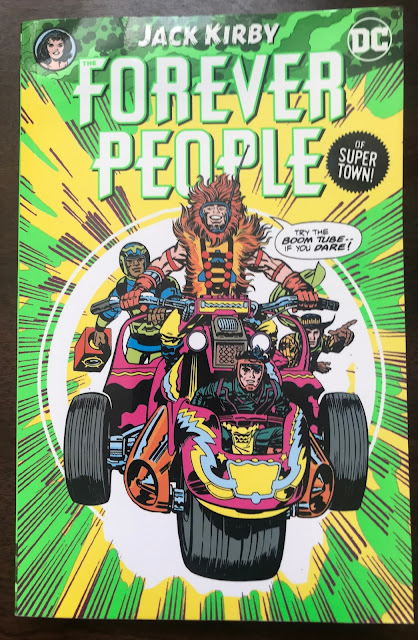
I Really Should Read This 11: Forever People, by Jack Kirby

Forever People, by Jack Kirby

1970, collected in 2020

I had read in some places that Forever People was one of the weak links in Kirby's Fourth World. After reading it? It's not his best!


Since last summer, I've read New Gods, Mister Miracle, and the Demon of 70s Kirby work, and the Eternals from his 70s Marvel. To be fair to the Forever People, it's worse by a matter of degrees, but none of it is flawless. All these works have really high highs, and really really low lows. I still had a ton of moments in this where I delighted at what I was reading.

Not one of these characters' names give a hint of their character

I'm not going to make a big issue out of it, the characters are what they are, but Vykin the Black is a poorly-named character. Around issue five, a Japanese character is introduced, Sonny Sumo. Vykin the Black is DC's first black superhero. Kirby was trying to broaden the scope of the comics, but he was also in his 50s. By modern standards, it's laughable, but his heart was in the right place.

All of these characters look great; Kirby was great at designing, but, like the New Gods and the Eternals, their names and powers are generally vague. Mark Moonrider has a "megaton touch." Serifan has capsules on his cowboy hat that can do what the story calls for. Only Beautiful Dreamer has a power that can survive an elevator pitch: she can pull images out of your mind and make them temporarily real. Compared to the characters he made with Stan Lee in the 60s, they don't have the same hook. Kirby was pretty free to run with his imagination, but maybe he was well-served by having someone to bounce ideas off of from time to time.

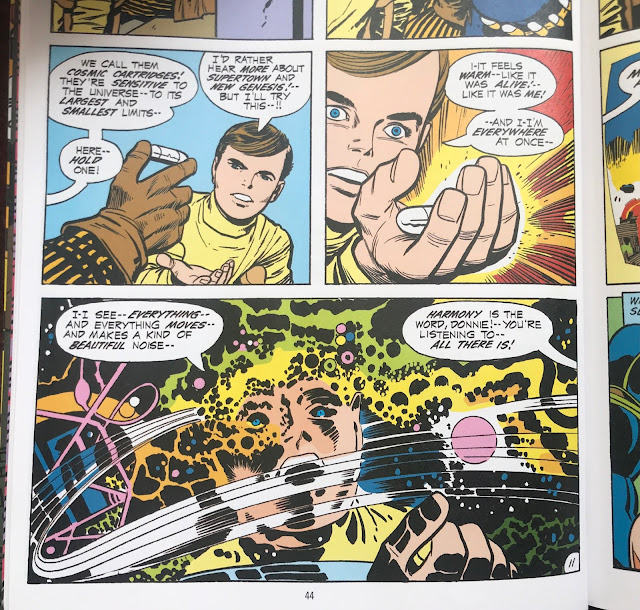
What else about the Forever People? They're from a place in New Genesis called Supertown, and when they put their hands together and say the word TAARU they change into Infinity Man (whom they have an arrangement with).

This is about all the explanation Infinity Man gets

It's not an easy read. Kirby had so many ideas, and he picks them up and drops them at a whim. On the stands, as single issues, they likely worked fine, with each issue overflowing with new concepts. But as an 11 issue collection, they don't make much sense when read as a whole.

He talks about the Omega Effect and the Anti-Life Equation, and as best I understand it the Anti-Life Equation is a kind of fascist mind control that obliterates free will, but I don't understand it. I just go along for the ride. I just finished Grant Morrison's Batman Omnibus Two, which uses these concepts from the New Gods, and I didn't understand it much there either.

I think if Infinity Man had become a bigger character, his look wouldn't feel so generic-Kirby

Infinity Man seems like a bad name, and an uninspired costume, and I didn't like him at all. After, I was looking at the costume, and it's not so much better or worse than other Kirby designs, but probably the name and lack of personality meant that it didn't click with me or with readers. It's not a bad idea, it's like Captain Marvel/Shazam, but with a team instead of a single kid, but then Kirby moves on from it. After issue three, this character I disliked so much disappeared from the book and this aspect of the Forever People is ignored. In the final issue, they announce Infinity Man is back! and I had all but forgotten he existed. 

Hmmm

The Forever People are modeled on hippies, and hippies are referenced in places. Kirby was trying to stay in touch with the kids. They sometimes talk about peace and love. The final issues of the book, the Forever People rent a room with a retired ex-flapper named Mrs. Magruder and we get to see the generation gap play out. Mrs. Magruder says things like, "Well, I never --!" It's entertaining, but it's not a justification to buy the book.

One of the first pages that really floored me. It's creepy, bold, and that's a Kirby gun if ever there was one

The art and relentless novelty of the images are the justification to buy the book. The book is reinvented a few times in its 11 issue run. This is part of the first wave of post-Marvel Kirby DC books, and he was still finding his new footing. By the Demon, he had really gotten into the swing of it, lots of splash pages and he regularly did double page spreads on pages 2 and 3 that I got really excited to see each issue. With this book, the art is good from the start, but it's a few issues in before he starts running wild with it.

That is a horse. Cut it out and plaster it on a giant canvas, and it's an futurist painting from the 1910s that sells for millions

The more New Genesis and Apokalips stuff he throws in, the better. It's weird, it's idiosyncratic, and I can't get enough of it.

Page 2-3 double page spread. It's so good

He has a time travel story in the middle, "I'll Find You in Yesterday!" where he goes wild drawing Abraham Lincoln, Spanish Conquistadors, and Roman Centurions. Sure, I'm happy to read that.

He just felt like drawing this

A lot of this Kirby work can be a hard read for modern readers, myself included. The pacing and the overdone narration can be a slog. It was made as disposable work for children and not to be overanalyzed by adults. So some of the criticisms I would have for a 21st century book aren't applicable. I appreciate the aspects that appeal to me now, and am able to brush aside the stuff that was never targeted at me. 
Over the coronavirus lockdown, I took the time to really read Kirby's work and not just admire the artwork. It took a long time, maybe 20 to 30 issues, to get my head synced up to the pace of his books. And this is the ninth fat trade collection of his work I've read cover to cover in the past year. I'm into it. I like it. Unironically, without reservations, it's just good work.

Friday, January 29, 2021

I Really Should Read This 5: Fantastic Four Epic Collection 5 (issues 68-87), by Jack Kirby and Stan Lee

Fantastic Four Epic Collection 5 (issues 68-87), by Jack Kirby and Stan Lee

late 60's

I've been doing a read through of the Kirby/Lee FF run since summer. These are 400 page collections that read like they're 800 pages thanks to Stan Lee just forcing himself onto every page*. The first issues I read, I could only read half an issue at a time, they simply made me tired, but there was something enjoyable to them. The more I read, the more I got with it and now can read two issues at a time. I think if you culled half the text from any given issue, they would be so much better. Lee has flair, but there's just too much of it.


They look great though. The art in this era is inked by Joe Sinnott, who was the Kirby inker I liked most before getting turned onto Mike Royer. The bold, chunky lines are beautiful.
As stories, the ideas are great, but these were meant for kids, and they weren't meant to be reread by adults 50 years after the fact. An issue has a ton of stuff thrown at the wall, page after page, and a tidy resolution or cliffhanger at the end. Once I got that, I could just enjoy the ride, not looking for a traditional story.
I have one more collection to read to finish off this run. I'm going to wait a month or two to get to it, but it's been really enjoyable to read the run of comics that built the Marvel universe, that made Lee and Kirby into legendary creators, and inspired the artists that inspired me as a kid, like Walt Simonson and John Byrne.
*It's very well-known among comics readers, but not so much among the general public the writing style that made Stan Lee the face of comics in America until the day he died was this: he made a pitch to the artist, like, Doom catches the Fantastic Four and takes away their powers! Then the artist went home and drew 20 pages to tell that story. All subplots, character work, design, 'acting' etc was done by the artist. They gave the pages to Stan, and he scripted it, usually over scripting, explaining exactly what readers could already see, and finally slapped his own name down first in the credits. He was the publisher's nephew. That's how he 'wrote' 10-20 comics a month.