Showing posts with label Nina Bunjevac. Show all posts

Thursday, April 15, 2021

Reading Through 2021 75: Bezimena, by Nina Bunjevac

 Bezimena, by Nina Bunjevac

2019

Last month, I read Bujevac's Fatherland, and it was very good, if a heavy read. And that's okay. The world of comics needs heavy reads. Bezimena? Heavier!

This cover will either draw people in or push them away. It obviously "sexy", but not a very sexy kind of sexy 
Up front, I'll just say this book was doing and saying some things I didn't quite understand. And it was the kind of lack of understanding where I'm not sure if others would clearly get it and I was simply thick, or if it was poetic imagery which isn't supposed to be concretely interpreted. It doesn't hurt my appreciation of the book, but I'm sure some people are taking things from this book that I didn't on first read. That's the level of book this is. The story is not a simple problem to solve.

There is a layer of myth over the book

The main story I understood just fine: Benny, an upper middle class boy in the 1930's or so, has sexual issues. As a boy, he can't stop touching himself, and as a man, he is barely employed because he's not okay.

From an early age, Benny can't keep his hands off of himself, regardless of the consequences

This is the story of a sexual predator, told from the point of view of the predator, and a somewhat sympathetic one. Bunjevac is in no way approving of the behavior, but portrays Benny as someone not in control of their faculties. He's not malicious in his behavior.

This is what Benny sees

Most of the book is this, Benny's story. It's explicit and uncomfortable, and much of it I can't post pictures of without making this blog more adult than I would like it to be. But this is a book that goes to places most comics cannot.  Sometimes the sexual images are beautiful: Benny is compelled by lust, and obviously on some level he is tempted by beauty and pleasure. But the images are also grotesque and cruel. Benny is hurting women. 

The ugly is rendered equal to the beautiful
Bunjevac draws all images equally dispassionately. That's probably what's most notable about this book: the simple, the complex, the beautiful and the ugly are are rendered with the same intricate, mechanical distance. Bunjevac is putting her heart in all of this, but never changes her tone. 

A typical two page spread

The book is almost entirely built on a single rhythm, a black left side page with a text balloon or two, and a full page image on the right side.

A close up of that last page. An unbelievable amount of time has been spent on each page
In some ways, this book is only borderline a comic, as it used almost no panels, and no word balloons in the pictures. It could be considered an illustrated book. Still, it breaks that convention in places, and is telling a story through word balloons, so it's comic enough. I could understand if someone wanted to classify it as "not a comic" though.

One of the few examples of "comic" work in the book
The book uses framing of am ancient priestess showing a woman Benny's life, and in the story Benny has dreams of himself as a stag, and these parts I couldn't quite wrap my head around. The book cover describes allusions to the myth of Artemis, and I'll trust it. I read it once, and I think this is a book to read twice or more to get its full meaning. It's a large book, but at one image per two page spread, it's a fairly brisk read. Only the distressing content keeps me from going back to it soon.
A hauntingly beautiful image

Bunjevac writes an afterword piece about a near-rape experience she had as a teen which informed the book. That was an experience which altered the way she saw the world. She's not using rape as a plot device or source of pain as has been seen in comics, she's grappling with how men who don't want to think of themselves as bad could still do such a horrible thing. It's a hard idea to confront.

Thursday, March 4, 2021

I Really Should Read This 13: Fatherland, by Nina Bunjevac

Fatherland, by Nina Bunjevac

2015

I've heard Bunjevac's name come up for the last few years, especially since Bezimena came out. I actually ordered that book around New Years, but am still waiting on it. In the meantime, I found a copy of Fatherland and decided to give it a read.


This is a good book. It's not a fun book, it's a mature, personal, thoughtful book.

The idea behind this book is very strong. It's a history of Bunjevac's family, specifically her father. She lays out her own personal situation in the opening chapters of the book: she was born in Canada in the 70s to two immigrants from then-Yugoslavia, and was soon taken back to Yugoslavia with her mother to be raised with her mother's family. There, her father is either never spoken of or spoken badly of, until his reported death in a bomb-making accident.


From there, the book delves into what made her father who he was. Bunjevac herself doesn't remember him, she only knows him from pictures and stories. In order to understand him, she has to delve into the history of Yugoslavia and the Croatian and Serbian conflicts there. The book does some information dumps here and there, but for the most part keeps things personal, highlighting how the government regime changes and ethnic tensions affected her family, pushing and pulling them, and traumatizing them as well as most of the population.

The key with this is that it is personal. History can be a dry or abstract subject, but the history in this doesn't feel like that. Her father is directly affected by the tide of history and ends up in Canada, but he never lets go of his Serbian upbringing.

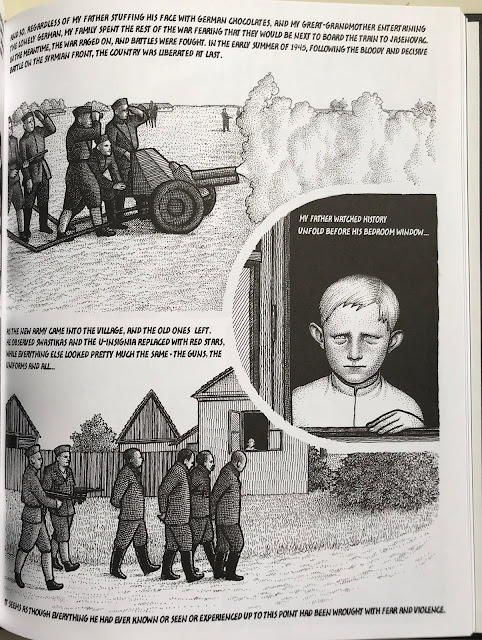
The most striking thing about the work is the art. It is very controlled yet manages not to be stiff. There is a photographic quality to it, but it's a byproduct of the rendering style as opposed to everything being rooted in photographs. Bunjevac certainly uses photos in places. The cover is a family photo, and in different places in the book she uses old photos to show snapshots of family memories. It's not an art style that I love, but it's impressive and quite unlike any artist working today. 

Fatherland tells a story that I've never read: the life of a man leading up to him becoming a terrorist and losing his family. He's not a good guy, but he's not a bad guy in the book either. He's a troubled guy.

I go into books like this, true family stories mixed with real history, with trepidation, because they can be so heavy (for another example, Thi Bui's The Best We Could Do). This is heavy too. After reading this, I'm glad I read it, and it left a strong impression. It's really good. I have to go read something more escapist after this though.