Showing posts with label 1970s. Show all posts

Sunday, November 28, 2021

Shigeru Mizuki's Spirit Manga Exhibition

 I recently had to fortune to visit an exhibition looking at the career of Shigeru Mizuki. A fantastic exhibit. Click through to read.


Shigeru Mizuki Spirits Manga Exhibition

Reading Through 2021 103: The Eternals by Jack Kirby


 I have decided to keep writing, but I will be posting on a separate blog space, POP: Culture and Comics. 

The logic being that I can manage a little more random traffic on a site already populated by other writers, and on their end, I suppose I write about work that the people there aren't writing about already. 

My first piece is on the Eternals, the original one, not the many many attempts to make them happen.  Click through and read there!

70s art meets 21st century coloring

Kirby's Eternals

Wednesday, August 18, 2021

Reading Through 2021 101: Morbius Epic Collection 1: The Living Vampire

 Morbius: The Living Vampire (Epic Collection 1), by Steve Gerber, Gil Kane, and dozens more 

1971 to 1974, collected in 2021

One of my great personal discoveries of the Covid era has been 70s Marvel. I became a Marvel reader in the 80s, and 60s stuff was sometimes reprinted then, but there was this window of publishing, roughly between Kirby leaving in the early 70s and Jim Shooter becoming editor-in-chief in the late 70s, that didn't get much if any attention. I can't argue that it's good stuff meant to stand the test of time, but it's been a pleasure to read.

Putting Blade on the cover: cash grab!

When I saw the Morbius Epic Collection, it seemed like a cash grab tie-in for the long-delayed Sony movie, and I'm sure it is. But I was surprised to learn that there was an attempt to make Morbius a headlining character for a while in the 70s. I'd read his first appearances in Amazing Spider-Man through a dollar bin copy, but that was over 30 years ago. I knew he was Dr. Michael Morbius, a doctor with a blood disease who attempted to cure himself with a vampire bat serum. In doing so, he gains vampire powers, but loses Martine, the love of his life. There was a lot about the character I didn't know.

The first appearance of Morbius was in a legendarily ridiculous story where Spider-Man gets six arms

That was the draw to picking this collection up, reading those headlining stories. I enjoy these Epic Collections overall, but I've avoided the collections of characters like Sub-Mariner (who I love) and Venom (who I don't) because they can be simply a lot of odds and ends appearances in other characters' books. About a quarter of the stories in this collection are just that: appearances as the villain in another character's book. The rest are a very deliberate attempt to make a lead character out of the living vampire.

His second appearance is against Spider-Man and the original X-Men in Marvel Team-Up, drawn with an absolute lack of love and attention by Gil Kane
After a few appearances as a villain in Spider-Man books, he was given the lead in a black and white magazine called Vampire Tales, and shortly after, he started headlining a second book called Fear (or more ridiculously, Adventures into Fear with the Man Called Morbius the Living Vampire).

No Comics Code Authority seal on Vampire Tales!

While I enjoy his appearances as a villain, it's these attempts to make Morbius a star that are the draw of this book. There's nothing connecting the two concurrent series except Morbius himself, and both feature a rotation of artists and writers keeping either from being coherent when read as a whole. There's a quality of the artist's game Decapitated Corpse here, where every few issues it's passed along to someone else and that creator tries to make heads or tails of what they've been given.

Paul Gulacy gives a sinewy take on the character

Let me try to break down the general structure of Fear, issues 20 - 26. If it doesn't exactly make sense, then, yes, you understand correctly:

-20, written by Mike Friedrich, art by Paul Gulacy. Morbius has come to Los Angeles. He is confronted by Reverend Daemond, a demonic priest who mind controls Morbius and sends him to kill "The most innocent child (he's) ever seen!"

-21, written by Steve Gerber, art by Gil Kane. The little girl he was sent to kill, Tara, is revealed to have powers to incarnate a future version of herself. Morbius saves her and takes her to the Caretakers, humanoid aliens that crashed on Earth when humanity was still in the trees, and helped guide us as a species. They frame the battle with Reverend Daemond as a battle between the supernatural and science for the fate of the world, and send Morbius to kill Daemond. Daemond sends a cat person to attack Morbius and is seen to be manipulating Morbius' love, Martine.

Is this the most innocent child you've ever seen?!
-22, written by Gerber, art by Rich Buckler and L. Dominguez. Morbius and the cat person are summoned to The Land Within, an underground city with a giant orb to light it. He was brought there by the leaders of the cat people to deal with a population crisis. Because life is so peaceful, the population keeps growing, and food and air will eventually run out. So they've brought a vampire to naturally lower the population. Morbius rejects being used as a weapon against innocents, so he jumps in a river. Yes, it ends with him on a river asking "Where does this river lead?"

I expect to see the Land Within around Phase 6 of the MCU

-23, written by Gerber, art by P. Craig Russell (credited here without his P.). Morbius finds himself on the planet Arcturus, a planet of freaks. He's guided by a character confusingly called "I", whose face is an eye. Gerber was having some fun, but the comic is utterly off the rails at this point. To connect it to the earlier issues, it's revealed that the reason everyone is a freak is because of the interference of the Caretakers before they'd reached Earth, casting doubt on whose side Morbius should be on.

What if the freaks were normal, and the normals were the freaks? Mind blown
-24, with the same creative team! Morbius and I take a spaceship to Earth that crashes in a city where Blade, Vampire Hunter is hunting vampires. I is killed in the crash, while Morbius escapes. Blade sees Morbius and they have a fight, but Blade is thrown off by the fact that science vampire Morbius isn't afraid of Christian symbols like a supernatural vampire would be, giving Morbius a chance to escape. 

-25, script by Doug Moench, plot by Gerber, and art by Frank Robbins.  The sixth part of this storyline starts to tie it all together, as Morbius returns to confront Reverend Daemond. Morbius joins up with the Tara to take down Daemond's forces, but the Caretakers realize that Morbius is against them too, so they decide to go after both Daemond and Morbius, leading to the seventh and final part.

This reads as someone who was looking at Kirby, but didn't quite have the energy to fully channel his mojo
26, written by Moench, art by Robbins. The Caretakers' forces arrive to fight the Daemond, but realize they have a common enemy in Morbius and Tara. Tara is revealed to have pitted the two sides against one another, and energy swirls around her as she begs Morbius to kill her while she is still in control. He kills her. Then the plug is pulled on the arc and it's over.
I don't think Marvel today would allow a vampire to feed on a child, even a possessed one
The seven issue run had three writers and five artists, and this was at the height of the Marvel method where writers gave artists plots, not scripts, so the artists were contributing a fair amount to the story, and it was tied together with the final script. 

On the one hand, it's like a sprawling sci-fi version of The Big Sleep or The Long Goodbye, with Morbius being bounced around from side to side, and the outcome being there are no good guys. On the other hand, it's a complete mess, and utterly incoherent, with characters switching directions over and over because the artists couldn't be bothered to follow what came before. I think a single writer and artist could actually remake this into something amazing, but that would be the key: a single set of creators for the whole of it.

And I kind of loved it. If this was all I ever read, it'd wear me down pretty quickly, but it felt like a wonderful antidote to the seriousness of contemporary genre writing. It's a treat to be surprised in every issue, and not merely have a plodding progression (I was reading Jonathan Hickman's Fantastic Four run as I read this, and they couldn't be more different).

I never saw this on the shelf, but it does take me back to the style of stuff that was out when I was a kid
The stories in Vampire Tales are of a very different tone, much more episodic. They reminded me of TV series with an overarching dramatic stake from back in the day, like the Fugitive or Quantum Leap.  Morbius and a woman he saves, Amanda, travel from town to town, and each one has some member of her family who has joined a Satanic cult. It's very B-movie type stuff. At a plot level, I could barely follow them, but in the moment they were fun. These were black and white magazines meant for a little older readership, so there's more sexual energy than the full color comics of the day, and lots of blood. 

Gallow's Bend is the setting for High Midnight, the vampire Western

The stories each try to have their own unique setting: a small town, a lighthouse on the shore, a Western ghost town. I enjoyed them well enough, but I had had enough by the time I finished the collection and wasn't itching for more. They were more professionally done than issues of Fear, but the drama in them didn't hook me.

It was baffling that these two series were running at the same time, but it shows that Marvel thought it was an interesting character, and probably there was positive, though not overwhelming, fan reaction at the time.

No, that was the formula that would finally allow Michael Morbius to live a normal life again!

The final story in the book is from another 70s character I have virtually no experience with, Werewolf by Night. Here, Morbius seems more like a Hulk character, a thoughtful scientist looking to cure his affliction. 

It seems like Marvel (I'm guessing Roy Thomas in particular) decided Morbius was something Marvel needed, as the Comics Code was loosening up and allowing supernatural characters to be published again. Marvel had science heroes, magic and mystical heroes, but not so much supernatural. Morbius wasn't a real vampire, he was a living vampire. But he was immediately sold as a vampire. That's not all that interesting, and when Morbius has been revived every ten to fifteen years, I haven't been compelled to check it out. I might have bought an issue of his Midnight Sons series in the 90s, but I don't even remember for sure... I bought some issues of Marvel's supernatural comics at that time, flipped through them and never touched them again. The supernatural in the Marvel universe has never been that appealing to me.  I don't think the character Morbius itself is very compelling either, it relies a lot on the creative team bringing something to it.

Of the issues in this collection, I really enjoyed the craziness of Fear.  It made the whole thing worth reading. And I always enjoy reading 70s Spider-Man, a book that would be hard to mess up; the foundation of the character, setting and design were so strong. All the same, there are other collections of 70s comics I'd recommend before this. This collection isn't consistent and the quality jumps from issue to issue. 

I did get to see a planet of freaks though, and that definitely made it worth my time.

Thursday, April 22, 2021

I Really Should Read This 25: The Collected Toppi: North America, by Toppi

The Collected Toppi: North America, by Toppi

1977-2007, collected in 2020

This is my first time writing about Toppi, it won't be my last.

Magnetic Collection love their rounded corners

Over and over again, algorithms kept recommending Toppi to me based on what I do online, and about the 20th time, I took the machine's advice and checked it out, and it turns out it was what I wanted to read. I wonder if I had seen this some of this stuff 30 years ago in Heavy Metal or somewhere, but if I had, I was too young to really appreciate it. 

The stories in this volume range from 1976 to 2007, but most fall in the 70s and 80s
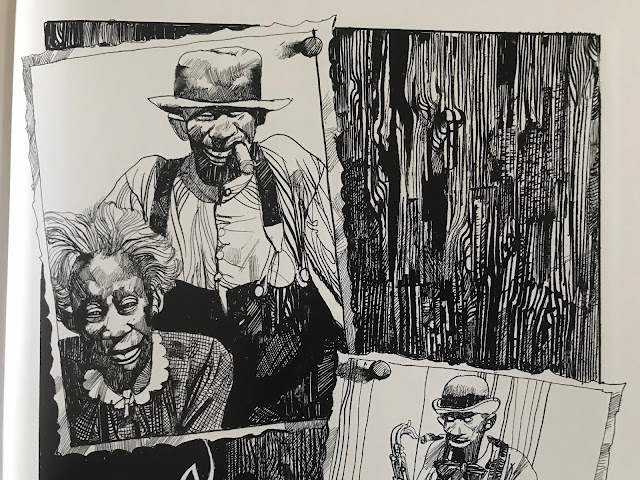
So, right up front, regardless of the quality of the writing, people are going to buy this for the art. Toppi draws the hell out of everything.

A shaman 
Every panel of every page is finely detailed and designed. I have no doubt that he got to a point in his art that he could produce this way without a lot of conscious planning: the textures, patches, spirals and strokes that make up his page have an organic quality like forms in nature have. I think that's the strength of it, his pages reflect the design of nature itself, like shapes in physics and biology. It's gorgeous to look at.

Not a lot of artists could make the grain of a wooden door look so compelling.
And there's more to it than just the images. He designs every page and panel to work with each other. Some combinations work better than others, but the guy has a rhythm of his own.

The inversion of positive and negative space between panels one and two is simple but striking, and lets the figures in the second jump out

Repeatedly as I read, I had to pause and take in how he was telling the story as much as I took in the stories themselves.
The bottom panels ascend in height as the characters ascend a slope
One other thing that stands out about his pages is that the panels are repeatedly broken, usually just a little, but it makes pages work as a unit rather than a collection of panels. Just a slight overlap here and there, but it prevents the panels from being rearranged. He's built a form-fitting construction of images.

The fourth panel commands the page by being the biggest, but it also does so by having the house slightly overlap into the first and third panel

This series, The Collected Toppi, is not typical of artist retrospectives. Often, books are done sequentially, with periods of an artist's work presented together. This series is by theme, with this book being North American stories. Other books feature Asia, Japan (technically Asia, but I get it, Japan gets more romanticized than the rest of the continent), South America, Africa, and a general fantasy theme one. Even within the book, the stories are not arranged sequentially. It frustrates the OCD part of me, but across 30 years Toppi's style was mostly consistent, so it isn't jarring to me as a reader. 

For the most part, North America means 19th century stories featuring white settlers and First Nations indigenous, with two stories in the volume about magical negroes, for lack of a better term. In some of the indigenous stories, the people have "magic", not in all. This is the writing of a man born in Italy in 1932, writing about the world, and so he worked in a lot of tropes verging on stereotypes. I'm fully aware of the contemporary discussion of topics in English Western culture, but I've also lived in Asia for 20 years and am aware that people in many countries enjoy their romanticized images of far away lands. The writing is not malicious in any way that I could notice, and generally had sympathy for the horror show that is the settlement of North America.

An Italian view of America's natives

That said, if today the Disney Corporation were to make a movie on the 19th century indigenous person's experiences, they're unlikely to consult the writing of a post-war Italian writer at any part of the process. 

I'm not going to say I'm blown away by the stories in here. These are largely old fashioned stories. These reminded me of Farley Mowat stories I might have read as a kid. In elementary school in Canada, here and there we would read tales of pioneers and explorers in Upper Canada. So they aren't super fresh to me now, but it's not a genre of story I see much in comics or film, so on that level, it's a change of pace.

A story with a samurai immigrant is colored with something like watercolors

What I like in the stories here is that there isn't a set morality or pattern of story. This isn't Uncle Scrooge where at the end of every story will have Uncle Scrooge rich and Donald Duck poor. A story where a man is warned to leave in peace could (and does) go a number of ways. He leaves and reflects on his wise decision. Or he doesn't leave and pays the price. Or he doesn't leave, and he deflates a myth and lives a long life. Toppi wasn't making stories in a clear tradition, and if there is any moral to the stories, it's that every story is different and one size doesn't fit all.


Ultimately though, if Toppi weren't drawing these stories, they'd be of limited appeal. Without his line work, they'd lose so much of their gravitas. 

There are four of these Toppi collections published, with two more on the way. I'm getting all of them. Maybe they'll start to feel repetitive after a few, but with the two I've read, I think that the six will be a very good amount of his stories and I may be interested in getting more.

Tuesday, March 23, 2021

I Really Should Read This 19: Streets of Paris, Streets of Murder 1, by Manchette and Tardi

Streets of Paris, Streets of Murder 1, by Manchette and Tardi

1978, 2005, 1980, collected edition published in 2020

Now I have a new artist to buy everything from: Tardi.


I ordered this two-book slipcase Tardi collection in November, and had given up hope on it arriving. It was released in November, so I should have had it shortly after it came out, but it arrived last week, some five months later. 

Why did I buy it, other than the fact that I've been buying too much since I stopped going out due to a pandemic? The past year I've been filling in holes in my reading, and I figured I should know some Tardi. I've even read some in my life. I saw his work in RAW 25 years ago, and though it looked good, it didn't make a huge impression on me back then. I just felt like reading it though. The noir vibe was something I was in the mood for. And this book blew me away.

No, not like that

It collects three works authored by a French novelist, Jean-Patrick Manchette, and drawn by Tardi: Griffu, a detective story from 1978; West Coast Blues, a detective story without a detective from 2005; and Fatale, an unfinished story from 1980.

Just opening to the first pages, I was in love with how he rendered the city.
That car with one side over the curb in the second panel... it's stuff like that that gets me
His art manages a trick of that Disney animation can do so well: it's real without being realistic at all. There is a weight and mass to everything, but it is not rendered in an illusionary way. It's just ink on a page. I went through Griffu loving the art, and was surprised to see 
West Coast Blues appear in stark black and white, no grays. At first, I was thinking that the later work might be weaker in its illustration, looser, that the 25 years between the two stories had worn him down a little, but no, it's just different. Probably he spent a little less time with a ruler in the second story, but it's a masterfully drawn work.

Showing off by drawing three completely different car models

Griffu was a good story. Not incredible. I'm not a noir super fan, but I'm aware of the genre, and this is the sort of story like the Big Sleep or the Long Goodbye, where the detective bounces around the city getting little sleep, barely figuring out what is happening, and getting a lot of bruises.
Not such a nice lead character
It's written by an older established writer in 1980, so there are a lot of little racist nods in the story (for example, Griffu continues to call the hotel clerk Mohammed after the clerk corrects him that his name is Rasak). As a reader in 2021, I try to figure out if the writer is writing a character that is racist, if the writer is being racist himself, or if France in that period was, and I can't figure that out, and it's probably a bit of each. It's too much for me to dissect. It wasn't overwhelming anyway, just noticeably not something we'd likely see today. It did make me think about whether the hero of a story needs to be a "good guy." Griffu is not quite a good guy. I'd have a hard time even pinning down his motivation by the end of the story.
That first thought balloon made me laugh out loud

It's a winding story with a dark ending, and it was good, but I liked the art more than the story. It was a good story with great art.

That's a big phone. The panel layouts in this are gold. Bold, clear images bathed in shadow

The second story though, wow, it is flawless. I was riveted from start to finish, and it was about something. A frustrated man is out driving one night and rescues another man from a car accident. That man had been in an assassination attempt and the killers are sent to clean up the rescuer afterward. That's it, a story of a Good Samaritan being punished. The story spins away from there, without a clean, straight-forward plot. It goes unexpected places and has a strange resolution which works as a pulp story but works as something more introspective as well.

After, I thought about my own boring life. It was a great 80-page story. It's amazing what a writer can do with a limited number of pages. 

The rest of the book is a 21-page story called Fatale, that was originally going to be 60 pages. It sounds like an unsatisfying read, but those 21 pages are all set up. While there is no resolution, it ends up reading more like a character sketch than the first chapter of a book. And it has one of the more striking images I've seen in a comic in a while.
A happy person wouldn't do this
With the Ed Brubaker Criminal books, the Parker series, Stray Bullets and this, I think I am a noir fan. Either that or I'm just lucky to stick to the finer stories.

I have the second book of this waiting to go. I'm going to give it a few weeks so that it can all sink in better, but I'm excited to read it. And I'll have to start in on his World War I books after that. This is an expensive hobby.

Monday, February 22, 2021

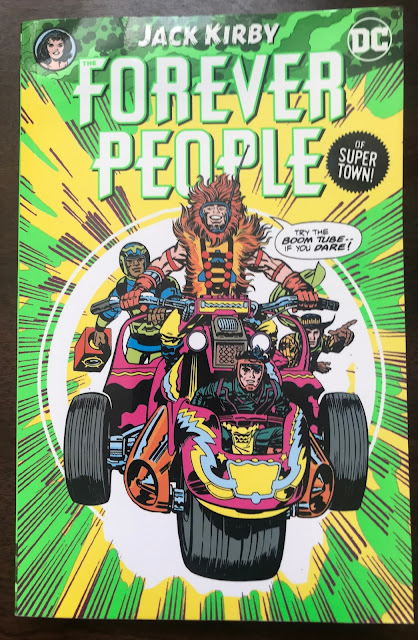
I Really Should Read This 11: Forever People, by Jack Kirby

Forever People, by Jack Kirby

1970, collected in 2020

I had read in some places that Forever People was one of the weak links in Kirby's Fourth World. After reading it? It's not his best!


Since last summer, I've read New Gods, Mister Miracle, and the Demon of 70s Kirby work, and the Eternals from his 70s Marvel. To be fair to the Forever People, it's worse by a matter of degrees, but none of it is flawless. All these works have really high highs, and really really low lows. I still had a ton of moments in this where I delighted at what I was reading.

Not one of these characters' names give a hint of their character

I'm not going to make a big issue out of it, the characters are what they are, but Vykin the Black is a poorly-named character. Around issue five, a Japanese character is introduced, Sonny Sumo. Vykin the Black is DC's first black superhero. Kirby was trying to broaden the scope of the comics, but he was also in his 50s. By modern standards, it's laughable, but his heart was in the right place.

All of these characters look great; Kirby was great at designing, but, like the New Gods and the Eternals, their names and powers are generally vague. Mark Moonrider has a "megaton touch." Serifan has capsules on his cowboy hat that can do what the story calls for. Only Beautiful Dreamer has a power that can survive an elevator pitch: she can pull images out of your mind and make them temporarily real. Compared to the characters he made with Stan Lee in the 60s, they don't have the same hook. Kirby was pretty free to run with his imagination, but maybe he was well-served by having someone to bounce ideas off of from time to time.

What else about the Forever People? They're from a place in New Genesis called Supertown, and when they put their hands together and say the word TAARU they change into Infinity Man (whom they have an arrangement with).

This is about all the explanation Infinity Man gets

It's not an easy read. Kirby had so many ideas, and he picks them up and drops them at a whim. On the stands, as single issues, they likely worked fine, with each issue overflowing with new concepts. But as an 11 issue collection, they don't make much sense when read as a whole.

He talks about the Omega Effect and the Anti-Life Equation, and as best I understand it the Anti-Life Equation is a kind of fascist mind control that obliterates free will, but I don't understand it. I just go along for the ride. I just finished Grant Morrison's Batman Omnibus Two, which uses these concepts from the New Gods, and I didn't understand it much there either.

I think if Infinity Man had become a bigger character, his look wouldn't feel so generic-Kirby

Infinity Man seems like a bad name, and an uninspired costume, and I didn't like him at all. After, I was looking at the costume, and it's not so much better or worse than other Kirby designs, but probably the name and lack of personality meant that it didn't click with me or with readers. It's not a bad idea, it's like Captain Marvel/Shazam, but with a team instead of a single kid, but then Kirby moves on from it. After issue three, this character I disliked so much disappeared from the book and this aspect of the Forever People is ignored. In the final issue, they announce Infinity Man is back! and I had all but forgotten he existed. 

Hmmm

The Forever People are modeled on hippies, and hippies are referenced in places. Kirby was trying to stay in touch with the kids. They sometimes talk about peace and love. The final issues of the book, the Forever People rent a room with a retired ex-flapper named Mrs. Magruder and we get to see the generation gap play out. Mrs. Magruder says things like, "Well, I never --!" It's entertaining, but it's not a justification to buy the book.

One of the first pages that really floored me. It's creepy, bold, and that's a Kirby gun if ever there was one

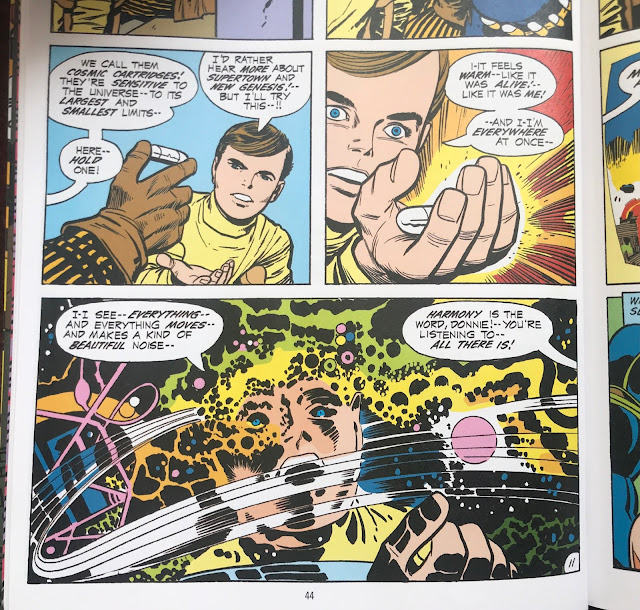
The art and relentless novelty of the images are the justification to buy the book. The book is reinvented a few times in its 11 issue run. This is part of the first wave of post-Marvel Kirby DC books, and he was still finding his new footing. By the Demon, he had really gotten into the swing of it, lots of splash pages and he regularly did double page spreads on pages 2 and 3 that I got really excited to see each issue. With this book, the art is good from the start, but it's a few issues in before he starts running wild with it.

That is a horse. Cut it out and plaster it on a giant canvas, and it's an futurist painting from the 1910s that sells for millions

The more New Genesis and Apokalips stuff he throws in, the better. It's weird, it's idiosyncratic, and I can't get enough of it.

Page 2-3 double page spread. It's so good

He has a time travel story in the middle, "I'll Find You in Yesterday!" where he goes wild drawing Abraham Lincoln, Spanish Conquistadors, and Roman Centurions. Sure, I'm happy to read that.

He just felt like drawing this

A lot of this Kirby work can be a hard read for modern readers, myself included. The pacing and the overdone narration can be a slog. It was made as disposable work for children and not to be overanalyzed by adults. So some of the criticisms I would have for a 21st century book aren't applicable. I appreciate the aspects that appeal to me now, and am able to brush aside the stuff that was never targeted at me. 
Over the coronavirus lockdown, I took the time to really read Kirby's work and not just admire the artwork. It took a long time, maybe 20 to 30 issues, to get my head synced up to the pace of his books. And this is the ninth fat trade collection of his work I've read cover to cover in the past year. I'm into it. I like it. Unironically, without reservations, it's just good work.

Friday, January 29, 2021

Reading Through 2021 11: The Troublemakers, by Baron Yoshimoto

The Troublemakers, by Baron Yoshimoto. c.1970s, translated by Ryan Holmberg 

2018


This is part of Ryan Holmberg's attempt to dramatically increase the amount of Gekiga (mature manga) available in English. It seems to be the first translated work by Yoshimoto. Right off the Batman that's a stunning cover, and representative of Yoshimoto's work. Most of the stories are about sex or violence. The stories are mostly about Japan in the 60s and 70s, though one story is about WWII in Europe. Gangsters, strippers, gamblers, aimless lower class folk, upper class folk exploiting their money... Yoshimoto writes about tough times.

The art is a mystery to me. The art in the early stories is super-tight, in a way I don't care much for, but he does some pages with a loose Japanese brush, which are beautiful. 


The WWII story veers into full Tezuka-style cartooniness. The essay at the back shows some samples of his work over the decades, so I have no real handle on what Yoshimoto's style actually is. 


Was he someone following his muse as his style evolved, or was he adjusting his style to suit what he could get paid to make? I don't know yet, but he certainly made some stunning images.


It's the first time I've ever read Yoshimoto's work and I'm definitely interested in reading more.

I want to see a book done with this brush!