Showing posts with label Canadian. Show all posts

Monday, May 3, 2021

Reading Through 2021 88: The Playboy, by Chester Brown

 The Playboy, by Chester Brown

1992, revised edition 2013

When I last read this book, I was a boy; now I am kind of a man.

The cover is a repurposed panel

Sometime around the mid-90s, I got turned on to the output of Drawn & Quarterly, and without a doubt, it changed my life. For one thing, it was the leveling up I needed to see from comics to justify keeping up with them. I love genre, but I couldn't subside on genre alone. I needed something with a deeper motive and a greater ambition to keep me from giving up on them all together. D&Q was that thing. It also helped that they were Canadian and helped me to see Canadian art as different than merely government funded would-be American art (there was a lot of not-so-great CanCon movies, music and TV in the 90s).  This book, along with the work of Seth and Joe Matt, gave me something to aspire to, though the work of those three is a pretty narrow spectrum through the lens of 2021.
The current version is smaller in size, with a lot more pages than the 90's version
So I had this, and all the rest of the D&Q books of the time, but I think I gave my copy of it away around the year 2000. It was long gone, anyway. More than once, I looked on my bookshelf for it and couldn't find it, so I finally just ordered a new copy. First thing I noticed was it's a new edition. The old edition was bigger, more panels on the page, black backgrounds, and if I remember correctly, a comment by Hugh Hefner. The new one has one or two panels per page, it's been re-scripted, and other subtle alterations which I missed.
I like the paper the new one is printed on, simple newsprint like a cheap novel has.
You can't buy pornography at the store near your house, for obvious reasons
The book in a nutshell is this: Brown tells autobiographical anecdotes about buying Playboy from teenage years to adulthood. It involves a lot of shame and being extremely conscious about all of it. Where to buy it, how to talk about it, how to dispose of it, how to carry it so that nobody thinks you're doing anything abnormal.
Hiding stuff in your shirt is a terrible idea. You hide it out in the open
Of course, he has his own personal details as to how he did things, but this hit home to me like few things I'd ever read at the time. Even today, it hits home. Pornography is pretty near universal in male experience, but in most circles, it's not something men want to talk about or acknowledge. It's embarrassing, verging into shameful. It depends on the person and their upbringing how much shame there is, but I was raised pretty non-religious, in a fairly open house, and I was mortified that someone might think I wanted to look at naked women. 

The use of pornography at the very least is universal, and if there is a guy who says he's never, then chances are he was simply using Sears catalogs instead. And it's a part of human experience. I studied the history of art, and one of my favorite quotes was by David Hockney (if I remember correctly), which went along the lines of, "It's only pornography for a hundred years, then it goes into a museum." It's been a constant in human culture. 

That's the kind of stuff I had to remind myself to not just feel like a skeeve.
The rituals of calculatedly disposing of his pornography is painful 
Brown lays it all out in detail the efforts he would go to to destroy evidence of having bought a Playboy, being haunted by not having it, and repurchasing it again, and eventually getting rid of the evidence again. It's painful, because he was doing it to himself. He wasn't being preached at by his parents or a reverend. He had just internalized this idea that wanting, having and using pornography was wrong.
So painful
The biggest takeaway is the honesty Brown shows throughout. Even as an adult writing about it, he isn't comfortable with it. In a Maus-like reflection of people reading his work in progress, he feigns not knowing about Playboy history in conversation with a guy who will likely read his comic a month later and see that he was lying. He's tackling the topic, yet he hasn't come to terms with it. It makes the whole project fascinating, and fairly unique. Autobiography was still a minor genre in comics, and rarely does the artist show themselves to be barely able to acknowledge in life what they're acknowledging on the page. Most autobiography is about topics someone has come to terms with.
Porn in forests and parks will never change. I've seen it in Japan lots too
My thoughts on this book, over twenty years after I last read it: it's much smaller than I remembered. At that time, trade paperbacks were still somewhat new. The original book was maybe 160 pages, which felt pretty substantial at the time, but feels quite short within the world of comics today, especially as Brown doesn't use half of the paper on the page. The landscape of comics has evolved a lot in the past 25 years and if it were released today, I think it would still get a lot of praise, but it feels slight compared to most alternative comics I buy.
How foolish of him to try to dispose of a magazine in the family fireplace
The book feels as personal now as it ever did. I've read a number of autobiographical comics this year, and all are revealing, some more than others. Maybe for me, because this resonates so deeply with my own experiences, it just feels that much harder of a book to have made. At this point, I could tell some of my own stories like this, but having read this book would make it easier, and I'd have to have some ironic distance from the "me" I were talking about.  Brown does have his own ironic distance as well, as he narrates the book in the form of a demon.

I imagine an eighteen year old today would still relate to this, though some of the details would be harder for them to imagine. Do young men buy magazines anymore? Maybe a young man today just amasses files on their hard drive, which they purge and rebuild repeatedly. I don't know, I don't talk to any teenagers. Maybe their porn is in the cloud. 
Can't just throw pornography out with your garbage. Someone might see it
This wasn't a book I was dying to get back, it was languishing in my online wishlist for about two years, but I just decided I should have it back on my shelf. Reading it reminded me how important it was for me, because I saw myself in a comic as much as I ever had. My own life had drama and conflict that I had never recognized.

Thursday, April 15, 2021

Reading Through 2021 75: Bezimena, by Nina Bunjevac

 Bezimena, by Nina Bunjevac

2019

Last month, I read Bujevac's Fatherland, and it was very good, if a heavy read. And that's okay. The world of comics needs heavy reads. Bezimena? Heavier!

This cover will either draw people in or push them away. It obviously "sexy", but not a very sexy kind of sexy 
Up front, I'll just say this book was doing and saying some things I didn't quite understand. And it was the kind of lack of understanding where I'm not sure if others would clearly get it and I was simply thick, or if it was poetic imagery which isn't supposed to be concretely interpreted. It doesn't hurt my appreciation of the book, but I'm sure some people are taking things from this book that I didn't on first read. That's the level of book this is. The story is not a simple problem to solve.

There is a layer of myth over the book

The main story I understood just fine: Benny, an upper middle class boy in the 1930's or so, has sexual issues. As a boy, he can't stop touching himself, and as a man, he is barely employed because he's not okay.

From an early age, Benny can't keep his hands off of himself, regardless of the consequences

This is the story of a sexual predator, told from the point of view of the predator, and a somewhat sympathetic one. Bunjevac is in no way approving of the behavior, but portrays Benny as someone not in control of their faculties. He's not malicious in his behavior.

This is what Benny sees

Most of the book is this, Benny's story. It's explicit and uncomfortable, and much of it I can't post pictures of without making this blog more adult than I would like it to be. But this is a book that goes to places most comics cannot.  Sometimes the sexual images are beautiful: Benny is compelled by lust, and obviously on some level he is tempted by beauty and pleasure. But the images are also grotesque and cruel. Benny is hurting women. 

The ugly is rendered equal to the beautiful
Bunjevac draws all images equally dispassionately. That's probably what's most notable about this book: the simple, the complex, the beautiful and the ugly are are rendered with the same intricate, mechanical distance. Bunjevac is putting her heart in all of this, but never changes her tone. 

A typical two page spread

The book is almost entirely built on a single rhythm, a black left side page with a text balloon or two, and a full page image on the right side.

A close up of that last page. An unbelievable amount of time has been spent on each page
In some ways, this book is only borderline a comic, as it used almost no panels, and no word balloons in the pictures. It could be considered an illustrated book. Still, it breaks that convention in places, and is telling a story through word balloons, so it's comic enough. I could understand if someone wanted to classify it as "not a comic" though.

One of the few examples of "comic" work in the book
The book uses framing of am ancient priestess showing a woman Benny's life, and in the story Benny has dreams of himself as a stag, and these parts I couldn't quite wrap my head around. The book cover describes allusions to the myth of Artemis, and I'll trust it. I read it once, and I think this is a book to read twice or more to get its full meaning. It's a large book, but at one image per two page spread, it's a fairly brisk read. Only the distressing content keeps me from going back to it soon.
A hauntingly beautiful image

Bunjevac writes an afterword piece about a near-rape experience she had as a teen which informed the book. That was an experience which altered the way she saw the world. She's not using rape as a plot device or source of pain as has been seen in comics, she's grappling with how men who don't want to think of themselves as bad could still do such a horrible thing. It's a hard idea to confront.

Thursday, March 4, 2021

I Really Should Read This 13: Fatherland, by Nina Bunjevac

Fatherland, by Nina Bunjevac

2015

I've heard Bunjevac's name come up for the last few years, especially since Bezimena came out. I actually ordered that book around New Years, but am still waiting on it. In the meantime, I found a copy of Fatherland and decided to give it a read.


This is a good book. It's not a fun book, it's a mature, personal, thoughtful book.

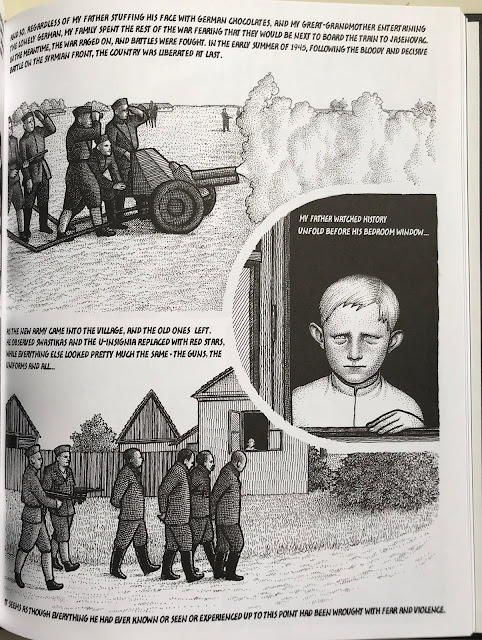
The idea behind this book is very strong. It's a history of Bunjevac's family, specifically her father. She lays out her own personal situation in the opening chapters of the book: she was born in Canada in the 70s to two immigrants from then-Yugoslavia, and was soon taken back to Yugoslavia with her mother to be raised with her mother's family. There, her father is either never spoken of or spoken badly of, until his reported death in a bomb-making accident.


From there, the book delves into what made her father who he was. Bunjevac herself doesn't remember him, she only knows him from pictures and stories. In order to understand him, she has to delve into the history of Yugoslavia and the Croatian and Serbian conflicts there. The book does some information dumps here and there, but for the most part keeps things personal, highlighting how the government regime changes and ethnic tensions affected her family, pushing and pulling them, and traumatizing them as well as most of the population.

The key with this is that it is personal. History can be a dry or abstract subject, but the history in this doesn't feel like that. Her father is directly affected by the tide of history and ends up in Canada, but he never lets go of his Serbian upbringing.

The most striking thing about the work is the art. It is very controlled yet manages not to be stiff. There is a photographic quality to it, but it's a byproduct of the rendering style as opposed to everything being rooted in photographs. Bunjevac certainly uses photos in places. The cover is a family photo, and in different places in the book she uses old photos to show snapshots of family memories. It's not an art style that I love, but it's impressive and quite unlike any artist working today. 

Fatherland tells a story that I've never read: the life of a man leading up to him becoming a terrorist and losing his family. He's not a good guy, but he's not a bad guy in the book either. He's a troubled guy.

I go into books like this, true family stories mixed with real history, with trepidation, because they can be so heavy (for another example, Thi Bui's The Best We Could Do). This is heavy too. After reading this, I'm glad I read it, and it left a strong impression. It's really good. I have to go read something more escapist after this though.

Friday, January 29, 2021

Reading Through 2021 8: To Know Your Alive, Dakota McFadzean

To Know Your Alive, Dakota McFadzean

2020

Some Can-Con comics, funded in part by the Canadian government!


McFadzean has been publishing comics for about a decade, and it's absolutely criminal that I have never seen his name mentioned on an American website. I'm sure it has, as he's been printed in some American magazines, but his three collections just don't get properly reviewed it seems.
I first saw his work through his daily comics on Tumblr. He spent a few years making daily strips, and you can see it in his inking and story-telling. He's put in the 10,000 hours already.


This is a collection of short stories from different publications, so there isn't a strong through line in them, except that he goes over a lot of the same themes. If I were to put a finger on his main topics, it would be existential horror and existential banality. I had three favorite stories in this. In one, a new kid at a school is bullied, but the kid is also rotten, so nobody is at fault and everybody is at fault. It's kids. In another, a woman gets a gig as a game tester and wonders what life she has. Another more surreal one has the world's first contact with an alien, and how boring it becomes a few weeks later when the next big news story breaks.


I kind of lean toward the existential banality ones, but he also has lots of stuff about faces melting off. He likes drawing faces coming off.

The art is really good, classical cartooning. In terms of modern artists, I can see Seth, Chester Brown, and Hartley Lin in his work. Clean, easy-to-read work. The only problem with this collection is that the works were originally formatted to different sizes, so the ones that were made to be printed on A3 paper are a little difficult to read compressed to the collection size. All the same, I think this is a phenomenal book, especially if you miss the Drawn and Quarterly and Fantagraphics books of the '90s.