Showing posts with label humor. Show all posts

Thursday, May 13, 2021

Reading Through 2021 95: Tales Designed to Thrizzle Volume One, by Michael Kupperman

Tales Designed to Thrizzle Volume One, by Michael Kupperman

2009

A little Michael Kupperman goes a long way.

I can't say I'm a life-long Kupperman fan. I watched the Robert Smigel's TV Playhouse when it was on, where Kupperman did animation. I first knew of his name though, when Tumblr was at its peak six or seven years ago. His work was perfect for a site like that: small doses of crazy, inventive humor. I was into it and got Volume Two of Thrizzle when it came out, and just recently decided I wanted some more and picked up the first volume.  
The sex hole v. sex blimp debate never ends
Kupperman makes short comedy pieces of the sort the Internet is sorely lacking. Humor strips these days tend to be four panel comics that are crudely drawn, with punchlines in the final panel, and not very inventive concepts of comedy. A quick pass through "comics" on Reddit this morning shows three dominant jokes: 1) a scary intimidating character does something cute in the final panel, 2) a cute character does something evil in the final panel, and 3) someone says something dumb and/or shocking while other characters stare in disbelief. That's 85% of the humor strips in my feed. Kupperman has themes he goes through, but I'd argue there is no formula, and jokes are laced throughout the strips, as opposed to a strip that builds to a single punchline. His art is retro, calling to mind work from the 30s to the 50s.
Meanwhile, the comics as literature debate has been settled
At times, it's barely a joke, simply a ridiculous concept that Kupperman has taken a great amount of effort to create. He also builds on his own strips, making callbacks to earlier strips and ideas. What might be a comic on one page becomes an fake advertisement on another. What is an advertisement on one page might face a rival advertisement on another. Like a lot of great comedians, he mines themes to get the humor out of them, and lets jokes evolve.
It's terrible when your Lyndon Johnson biography suffers because of having to perform foreplay
Kupperman was born in the 60's, and takes a lot of references from 70's culture, like buddy cop TV shows and the actors of the day, but he also works in a lot of Americana from old presidents to 1930's pulp stories. Most of the work in the book is familiar in some way, like it's been culled from the collective unconsciousness of America. He definitely is making more references than I can name check. This is dense work.

Remembering the Thirties
When he's on top of his game, it's absolutely delightful. It's novel in a way that humor comics rarely are. With the way the Internet has become, with endless scrolls asking for our attention, somehow it's rarely surprising. Kupperman manages to surprise over and over. Was I asking for for Einstein and Mark Twain as two beat cops solving crimes? No, and I wasn't asking their police chief to dress like Tarzan either.
If there's one issue I had with the book it's that it's that I couldn't just sit down and read it. This book collects four issues, and I had to read it about half an issue at a time. With books that collect a lot of short, unconnected pieces, there are some where I'm ready to burn through it, like Dakota McFadzean's excellent To Know You're Alive, but with this one, I found it hard to stay focused on it. I read it for fifteen minutes before or after reading something else.
From a piece on the pornographic coloring books of the 1970's
That's not really a criticism of the work, just recognizing that the form of one to four page strips without narratives don't lend themselves to concentrated readings.  I was delighted, then I was tired, then I was delighted again. It's good work.

Monday, March 29, 2021

One Coin Reads 19: Groo: Friends and Foes Vol. 3 by Sergio Aragones


Groo: Friends and Foes Vol. 3 by Sergio Aragones

2015

Sometimes you want comfort, and in those times, Groo is there for you.


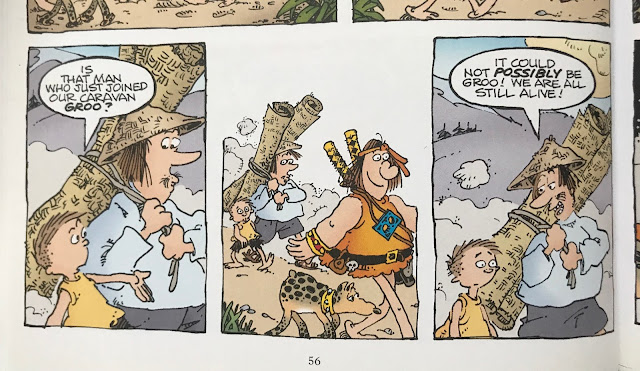
I don't know if there are hardcore Groo fans, in that in his near 40 years of existence, he didn't spawn toy lines, video games, or collectibles like many characters. But it must have sold enough to keep it in print. I was a Groo collector for about five years in the late 80s to early 90s, and bought lots of older issues in the discount bins. If I had to find a popular point of comparison for it, it would be like the Simpsons if the show had maintained all its best creators for the entirety of its run.

Groo has had one creative team for almost all its run: writer/artist Sergio Aragones, scripter Mark Evanier, letterer (and Usagi Yojimbo artist) Stan Sakai, and colorist Tom Luth. The first issue in this collection doesn't have Tom Luth, and that's the only time I ever saw the team broken up, but I haven't read a new Groo book in over twenty years. It's not a book that is based on story. It's a book that recycles the same jokes in an infinite variety. That's not a criticism at all. That's why it's great, you always get what you want when you read a Groo book.

Here is Groo:
-he is unfathomably stupid
-he will kill you if you call him a mendicant
-he likes cheese dip
-if you go against him, he will destroy your life
-if you work with him, he will destroy your life
-if you meet him, he will destroy your life

Groo travels with a dog, Rufferto, who is substantially smarter than Groo yet thinks Groo is a great man.

Somehow, Aragonés has managed to tell jokes based on this for decades and still make them funny. Evanier, who does the dialogue, deserves lots of credit for his work, which is often remarkable. He lets Groo say things in the least sensible way, and gives others dialogue to flesh them out perfectly. He also writes dozens of lines per issue in rhyming verse. I can't imagine how many rhymes he's done in his decades with the book. 

And so with this book, was it as good as the Groo I was reading twenty years before? Not quite, but surprisingly close.
Groo tries to find the father of a girl by asking everyone about a son's mother.  The non-Tom Luth coloring was too dark and over-shaded, and I was happy to see him return
The Groo from Epic Comics (and Pacific Comics and Image Comics) had a formula to their story. It was almost always one issue tales, sometimes two issues, but each issue would have a resolved ending even if a story thread continued. The first page was a set up, the second and third a ridiculously detailed two-page spread with lush lettering and poetry. Then the story would get increasingly convoluted before everything of value was destroyed because of Groo. It wasn't a moral book, but it often had classical irony where someone who tries to plot too much ends up having double the misfortune for their effort.

This series has most of that, but has relaxed the formula. The opening page of each issue is a poem by the Minstrel catching readers up. The two page spread is there, but where the story calls for it.
The ridiculous two page spreads are still in each issue, but not on pages two and three, and without the gorgeous titles
This story is a little different, it's issues 9-12 of a short series titled Friends and Foes, which was a sort of greatest hits for supporting characters, with an overarching plot about a young girl with an inheritance name Kayli who wants to find her father. Naturally, lots of characters want to capitalize on her wealth, except Groo. The story hurt the issues because time was devoted to featuring a character that wasn't really funny. The reader was meant to sympathize with Kayli, which is fine, but it wasn't what I liked from a Groo book.
Kayli is a decent, clever person

The chaos that ended each issue of the old series is here, but more so at the end of four issues than in each issue. Other than that, it's really close to what classic Groo was. Throughout the book, I laughed a lot. And it's really funny, not smirking funny, but actual laugh out loud funny. 

The essential components of a Groo book are still here. It's masterful how organically Aragones can weave a complicated story. A kingdom where music is outlawed forces musicians to gather outside the border. They get Groo to bang a drum and enter the kingdom so that the king's army will be killed by Groo when attempting to stop him. The king realizes he has to kill Groo or lose face, so he sends his army to a neighboring kingdom as an excuse not to attack him. This lets the musicians return and throw a festival. The king sees people flocking to his kingdom and has to stop the festival. The stories in Groo can be so complicated, but they are told clearly and with real humor.

A crazy festival inspired by Groo's drumming

And Aragonés art is incredible. He's a doodler, he's not doing realistic illustrations. But he has a huge variety in the clothes, the characters, the buildings. There is an unimaginable variety. I don't know where he gets his inspiration from, but everything looks unique. It's as impressive now as it ever was.

I'm not going out to buy more of these books because I have 100 issues of Groo already, and while I can remember some stories, they are so dense that rereading any of them still surprises me. I don't think you need every issue of Groo. This book was marked down and I bought it just to check out what Groo was up to in the 21st century. 

I'm happy to say, the Groo abides.

Monday, March 22, 2021

One Coin Reads 17: Trent, by Dino Stamatopoulos and Leah Tiscione

Trent, by Dino Stamatopoulos and Leah Tiscione

2017

Hands down, the weirdest thing I've read in years.


Dino Stamatopoulos is not famous, but he is well-known to comedy nerds as Starburns on Community and even better known to ultra-comedy nerds as one of the main writers on the legendary HBO sketch comedy Mr. Show.

Was Starburns the greatest thing about a great show?

He's a writer more often than a performer, but for years, if his name came up on a project, I'd check it out. So yeah, I was interested in buying Trent, and bought it not knowing it was a musical comic book about a dead baby. 

It's a musical comic book about a dead baby. 

In case you missed that on the cover

It wasn't going to be a home run. It's just too far out of the range of regular comics, neither fish nor fowl as the expression goes. Before even discussing what I thought of it, I need to explain how it works. 

The yellow box signals track one

The book is in black and white, but it shifts into color at certain segments. 
The color segments are musical, the black and white pages are plain comics. A track notification of what song to play from their website shows up with the color.

That site hosts the eight songs that appear in the book, which are mainly performed by Scott Adsit and Britta Phillips. Adsit is probably best known from his role on the sitcom 30 Rock and is an all around strong performer. Phillips was a name I didn't know, but she was actually singing in a very heartfelt way, and it turns out she was in the band Luna, a great little band in the 90's. The songs are all musical theater in nature, so it's nothing I would listen to outside of the experience of this comic, but it wasn't in any way amateur.

For the most part, Trent has no face

 And so, Trent tells the story of a couple who weren't excited to have a baby, have one that dies, and they learn to love the corpse. It's morbid humor. The chorus of the first song is, "I hope it's alive." 

The art by Tiscione is professional and well done, but it's not a style I enjoy. It seems like a style that might be in appear in a magazine to be read by people who don't usually read comics. I think the concept of the book needed to have 'straight' comic art. It's a book about normal people doing something very abnormal, so having art which leaned into the comedy would make it all less shocking and strange. So it's suitable and well done, just not exciting. Her art style wouldn't be out of place in a Muppets comic.

The neighbors have so many kids they can't count them

The book attempts to get into the head of people who are attempting to love a child they hardly knew, and there is room for pathos. The book gets a back cover blurb by none other than screenwriter Charlie Kaufman, who calls the book "touching." And there are poignant points, but it is buried in a lot of goofiness. If you enjoy the goofiness and the art, probably the whole package will be appealing though. 

The grandparents are hooded puppeteers focused on one thing only

I love Mr. Show, but even there, the musical numbers were usually my least favorite sketches, (until the tenth watch when they sometimes become beloved). And though I've seen comics with soundtracks before, not with musical numbers; this was different. Stamatopoulos wrote this as a comedic play 25 years ago, and self published it through SBI (Starburns Industries). It's a labor of love, but it's hard to call this successful, it reads like theater adapted to comics. It would have worked better as an animated special for Comedy Central. Any time a book comes with instructions, it can't be much more than a novelty. 

I don't even dislike it either. It's just weird. 

Thursday, February 11, 2021

Reading Through 2021 24: Seeds and Stems, by Simon Hanselmann

Seeds and Stems, by Simon Hanselmann

reprinting stories from the 2010s, published 2020

Is Simon Hanselmann the most successful indie creator out there right now? He's prolific, self-promoting, and it seems like his work is all over. If he's not the most successful, he's one of them at least. I've enjoyed his work since his days over on Tumblr and have got each of his books through Fantagraphics, so it was an easy choice to pick up his newest release, Seeds and Stems.

Without the slip cover
Upon getting it, I was a little disappointed. The page count is higher than his other books, but the book is a smaller size. Putting them next to his hardcovers, it's not a huge difference, but it feels like a pocketbook rather than a small book.

I like his work a lot, but I just had some apprehensions with this one. The size, but also it's a collection of odds and ends, leftovers, or seeds and stems as a disappointed stoner might say in the days before legal weed. The book collects work from anthologies and minicomics from the past decade. A lot of it is single color printing on colored paper, not the full color of his other books. One of the earlier appearing strips was originally printed as a poster, and man, my old eyes couldn't read it. Chris Ware makes tiny writing, but it's intentional. This is just shrunk down for economics. 

Actual printed size

But I burned through this book. I really, really enjoyed it. Maybe more than his longer stories in the other books. I don't know what it was. Probably because everything is so short, if you're not enjoying one story, you're quickly onto the next one. The thing this reminded me of most was those fat comic strip collections that were so popular in the 80's. I'd read a Calvin and Hobbes or Bloom County collection, and just lose myself in them. With this, it's 350 pages, and I probably read 70 pages at a time. That's a lot for me.
I relate to the choice of drugs, but yeah, drug rut, that's a real thing

There's a sitcom quality to it, but it's also got a newspaper comic strip vibe as well. The characters are constant, the setting is constant, and there are lots of jokes. Probably that's a major part of Hanselmann's success, that these strips are, despite the depression, drug use and fistings, very digestible. These are peak Megg, Mogg, and Owl strips. For the majority of these, he's in the zone. 
Hanselmann is always good with his silent panels and reaction shots
Personally, I relate to a lot of these strips. I spent a few years on the sofa like Megg, Mogg, and Owl. They watch How I Met Your Mother and Young Sheldon, I watched the Simpsons and Everybody Loves Raymond. The type of depressive antics of that lifestyle, you can't even tell what you honestly enjoy and what you ironically enjoy. There's just extreme boredom and a wish to escape it. Hanselmann has made a thousand pages capturing this weird nichey lifestyle and I'm all there for it.
He uses a variety of page colors in the book. It's an interesting production value

I don't know that I recommend this book above any of his other collections. It's good, there's a lot in it, but the others are good too, and lots are in them too. It's like those old newspaper strip collections. Some folks will want to own each and every one, but probably most people will be satisfied with a book or two. This one is as good as any of the others. I laughed.